
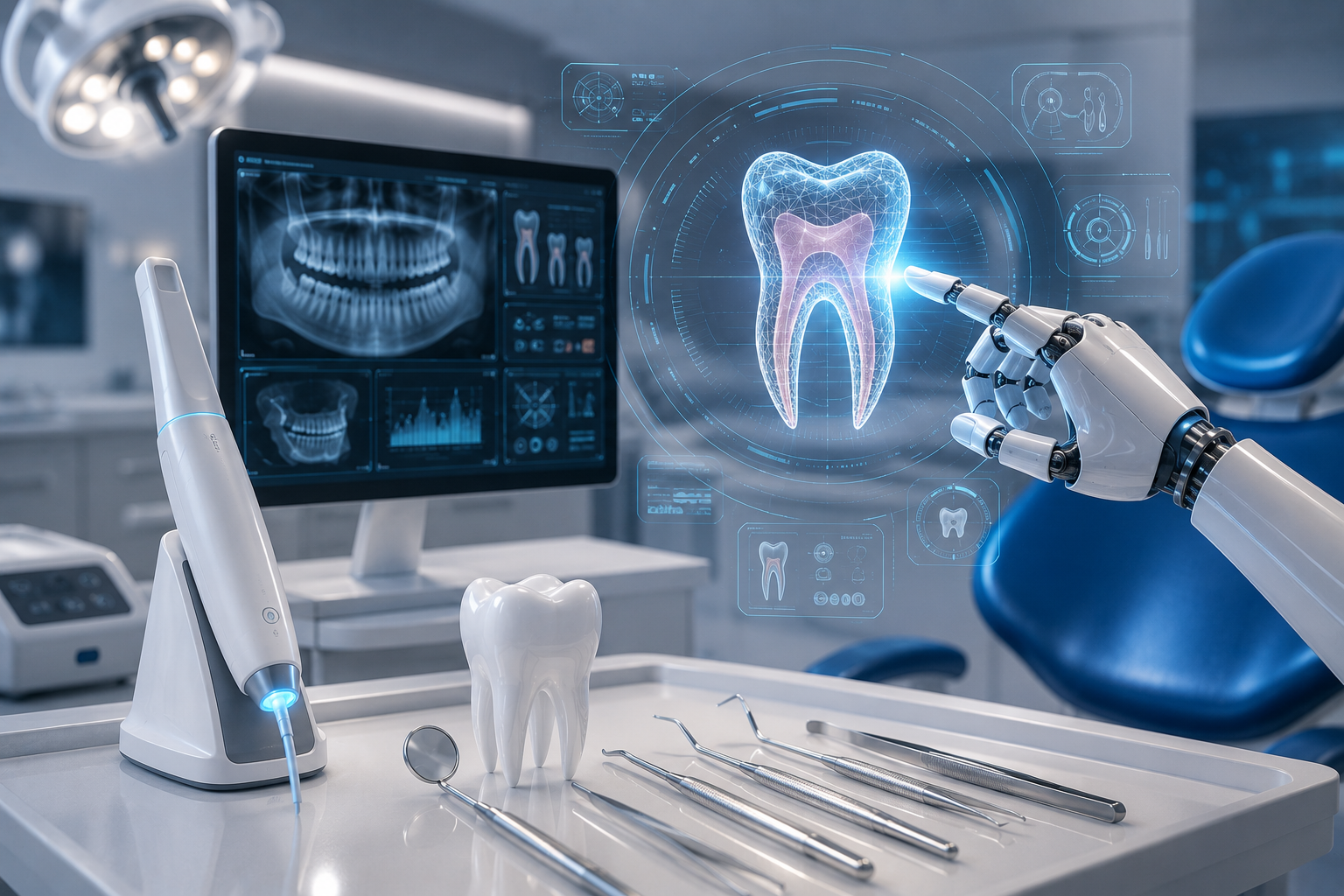
Artificial Intelligence is transforming dentistry faster than most professionals ever expected. In just a few years, AI has moved from being a futuristic concept into a real clinical and operational tool already being used inside dental practices across the world.
Today, AI can assist dentists with:
- Radiograph analysis
- Caries detection
- Periodontal measurements
- Clinical documentation
- Voice charting
- Insurance workflows
- Treatment simulations
- Appointment automation
- Smile design
- Predictive analytics
As these technologies continue improving, many professionals are beginning to ask an uncomfortable question:
“Will AI eventually replace dentists?”
The short answer is no.
But the deeper reality is far more interesting.
AI may replace large parts of traditional dentistry workflows — but it will not replace the dentist.
Instead, AI is likely to replace outdated systems, repetitive tasks, inefficient workflows, and certain traditional methods of practicing dentistry. The role of the dentist itself will not disappear. It will evolve.
The future of dentistry will not belong to AI alone.
It will belong to dentists who understand how to work alongside AI more effectively than others.
Dentistry Has Always Evolved Through Technology
Throughout history, dentistry has constantly changed through technological innovation.
At one time, dentists practiced without:
- Digital X-rays
- Intraoral cameras
- CBCT imaging
- CAD/CAM systems
- Dental implants
- Intraoral scanners
- Cloud software
Every major technological shift created fear in the beginning.
When digital radiography was introduced, some feared traditional radiographic interpretation skills would disappear. When CAD/CAM systems emerged, many believed laboratories would become obsolete. When intraoral scanners entered the market, people questioned whether conventional impressions would survive.
Yet dentistry did not disappear.
Instead, dentists adapted.
Technology changed the workflow —
not the profession itself.
AI represents another major transformation in that same historical pattern.
What AI Will Actually Replace
- AI is extremely powerful in areas involving:
- Pattern recognition
- Data analysis
- Repetitive tasks
- Automation
- Predictive calculations
This makes dentistry a natural environment for AI integration because modern dental practices generate enormous amounts of digital information every day.
AI is already replacing parts of dentistry that involve repetitive interpretation and administrative overload.
For example, AI software can now analyze radiographs and identify:
- Caries
- Bone loss
- Periapical lesions
- Calculus
- Marginal discrepancies
Platforms like Pearl AI and Overjet AI already assist dentists by highlighting suspicious areas on radiographs in seconds.
This does not eliminate the dentist.
But it changes how diagnosis is performed.
Instead of spending large amounts of time manually reviewing every image alone, dentists increasingly work with AI-assisted systems that improve consistency and efficiency.
Similarly, AI voice systems can now automate:
- Perio charting
- Clinical notes
- SOAP documentation
- Insurance narratives
Platforms like Bola AI and DentalBee AI are already reducing hours of administrative workload inside practices.
AI may eventually replace:
- Manual charting
- Traditional scheduling systems
- Insurance paperwork
- Repetitive documentation
- Certain diagnostic screening tasks
But replacing the dentist is an entirely different challenge.
Dentistry Is More Than Technical Information
One of the biggest misconceptions about AI is the belief that dentistry is purely technical.
Dentistry is not simply about identifying cavities or reading radiographs.
A real dentist must constantly make complex human decisions involving:
- Emotions
- Pain
- Fear
- Communication
- Ethics
- Financial limitations
- Patient expectations
- Esthetic judgment
- Human behavior
Two patients with the exact same clinical condition may require completely different treatment approaches depending on:
- Personality
- Anxiety level
- Budget
- Medical history
- Long-term goals
- Emotional comfort
AI struggles in areas involving:
- Human trust
- Empathy
- Emotional reassurance
- Ethical judgment
- Real-world unpredictability
A patient does not simply want a diagnosis.
They want confidence.
They want reassurance.
They want someone they trust when they are afraid, in pain, or uncertain.
That human relationship remains one of the most important parts of dentistry.
The Dentist of the Future Will Become More Valuable
Ironically, AI may actually increase the value of highly skilled dentists.
As automation handles repetitive tasks, dentists may spend more time focusing on:
- Complex treatment planning
- Esthetic decision-making
- Human communication
- Surgical precision
- Patient relationships
- High-level clinical judgment
This could elevate dentistry from:
Procedure-focused work → Strategy-focused healthcare.
In the future, dentists may function more like:
- Clinical architects
- Workflow leaders
- Treatment strategists
- AI-guided decision makers
rather than simply procedural operators.
The dentist who understands:
- AI systems
- Digital workflows
- Human psychology
- Advanced treatment planning
may become far more valuable than ever before.
AI Will Create a New Type of Dental Practice
The future dental clinic may look dramatically different from today’s practice.
Imagine a patient walking into a clinic in 2030.
AI systems automatically analyze:
- Radiographs
- CBCT scans
- Intraoral scans
- Facial scans
- Bite relationships
- Caries risk
- Periodontal risk
within seconds.
Voice AI generates clinical notes automatically during the consultation.
AI scheduling systems optimize appointments and workflow efficiency.
Treatment simulations show patients realistic smile outcomes before treatment even begins.
The dentist then reviews all this information and makes the final human decisions.
In this model:
AI becomes the assistant.
The dentist remains the leader.
Dentistry Is a Human Experience
One reason AI will not fully replace dentists is because dentistry is deeply human.
Patients often experience:
- Anxiety
- Fear
- Embarrassment
- Pain
- Financial stress
A machine cannot fully replace:
- Human reassurance
- Trust-building
- Compassion
- Personal communication
Consider a nervous child sitting in a dental chair for the first time.
AI may analyze radiographs perfectly.
But it cannot truly comfort the child like a compassionate dentist can.
Similarly, in cosmetic dentistry, patients often seek emotional transformation, confidence, and self-esteem improvements — not simply technical treatment.
Human emotional understanding remains critical in these situations.
The Real Risk Is Not AI Replacing Dentists
The real risk is something else entirely.
Dentists who refuse to adapt may be replaced by dentists who use AI effectively.
This is the real transformation happening in dentistry.
Clinics using AI-driven workflows may gain advantages in:
- Speed
- Efficiency
- Accuracy
- Communication
- Patient experience
- Workflow scalability
A dentist using AI may eventually outperform a dentist who relies entirely on traditional systems.
This pattern already happened in other industries.
Digital photography did not destroy photography.
But photographers who ignored digital technology struggled.
Online banking did not eliminate finance.
But it changed how financial professionals operate.
AI is likely to create the same shift inside dentistry.
The Future Dentist Will Need New Skills
The dentist of the future may require skills beyond traditional clinical training.
Future dentists may need strong understanding of:
- Digital workflows
- AI-assisted diagnostics
- Technology ecosystems
- Patient communication
- Data interpretation
- Digital treatment planning
The future dental leader may not necessarily be the dentist with the fastest hand skills alone.
Instead, it may be the dentist who best combines:
- Clinical expertise
- Technology intelligence
- Human connection
- Strategic thinking
Examples of AI Already Changing Dentistry
AI is no longer theoretical.
It is already happening now.
Diagnocat uses AI for CBCT interpretation and treatment planning.
DentalMonitoring allows orthodontists to remotely track aligner cases through AI-powered monitoring systems.
Pearl AI assists with radiographic diagnosis and pathology detection.
Overjet AI helps automate radiographic analysis and insurance workflows.
Bola AI automates voice perio charting and clinical documentation.
These technologies are already changing how dentistry operates every day.
But none of them eliminate the need for a dentist.
They enhance the dentist’s capabilities.
The Emotional Side of Dentistry Cannot Be Automated
One of the most overlooked realities about dentistry is that patients do not evaluate dentists only by technical skill.
Patients remember:
- How they were treated
- How safe they felt
- Whether they trusted the provider
- Whether the dentist listened
- Whether the experience felt personal
Trust remains one of the most important currencies in healthcare.
AI cannot fully replicate genuine human trust.
And healthcare without trust becomes transactional rather than therapeutic.nieve digital dentistry is transitioning from “innovative” to “indispensable.” (Institute of Digital Dentistry)
Final Thoughts
AI is absolutely going to transform dentistry.
It will automate many traditional workflows, improve diagnostics, reduce administrative burdens, accelerate treatment planning, and reshape the economics of dental practice.
In many ways, AI may replace large portions of how traditional dentistry currently operates.
But it will not replace the human dentist.
Instead, AI will likely eliminate:
- Inefficiency
- Repetitive tasks
- Manual workflows
- Administrative overload
- Outdated systems
The future belongs not to AI alone —
but to dentists who understand how to combine:
- Human intelligence
- Emotional connection
- Clinical expertise
- Digital workflows
- Artificial Intelligence
into one modern patient experience.
Because patients do not simply want algorithms.
They want trust.
They want confidence.
They want human care delivered with the power of advanced technology behind it.
And that is why AI may transform dentistry forever —
but the dentist will remain irreplaceable.