
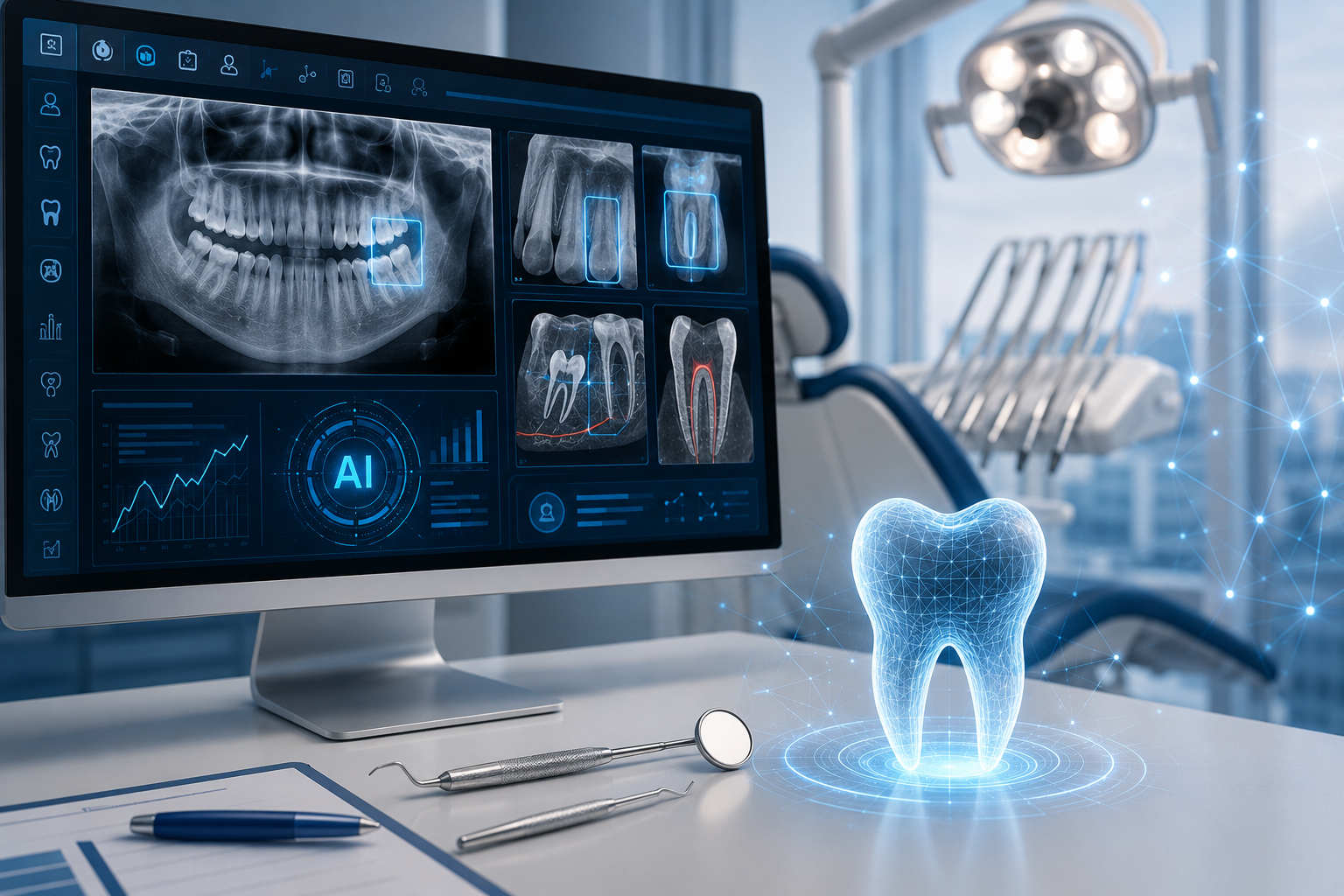
Artificial Intelligence (AI) is no longer a futuristic concept in dentistry—it is rapidly becoming an indispensable clinical assistant. From identifying early cavities on radiographs to detecting periodontal disease, oral cancer, and bone loss, AI-powered diagnostic systems are helping dentists make faster, more consistent, and data-driven clinical decisions.
In 2026, AI diagnostics are revolutionizing every stage of patient care. By combining machine learning, deep learning, digital imaging, and cloud computing, these systems assist clinicians in detecting disease earlier, reducing diagnostic variability, and improving treatment planning. Rather than replacing dentists, AI enhances clinical expertise by providing intelligent decision support that enables more accurate and predictable patient care.
According to digital dentistry trends featured by DenTrends, AI-powered diagnostics are becoming one of the most influential innovations shaping the future of oral healthcare.
What Are AI-Powered Diagnostics?
AI-powered diagnostics refer to the use of artificial intelligence algorithms to analyze dental images, patient records, clinical data, and diagnostic information to assist dentists in identifying oral diseases and recommending treatment options.
Using advanced deep learning models trained on millions of annotated dental images, AI software can recognize patterns that may be difficult to detect during routine examinations.
The technology functions as a digital clinical assistant that supports—but does not replace—the dentist’s professional judgment.
The Evolution of Dental Diagnosis
Traditional dental diagnosis relies on clinical examination, radiographic interpretation, and practitioner experience. While highly effective, diagnostic accuracy can vary depending on image quality, clinician experience, fatigue, and case complexity.
AI introduces a new level of consistency by analyzing radiographs with standardized algorithms capable of highlighting areas of concern within seconds.
This evolution shifts dentistry from subjective interpretation toward evidence-supported clinical decision-making.
How AI-Powered Diagnostics Work
Modern AI diagnostic platforms analyze multiple sources of clinical information, including:
- Bitewing radiographs
- Periapical X-rays
- Panoramic radiographs
- CBCT scans
- Intraoral photographs
- Intraoral scans
- Periodontal charting
- Patient medical history
Machine learning algorithms compare these datasets with extensive clinical databases to identify abnormalities, assess disease progression, and generate diagnostic insights.
The results are presented visually, often highlighting suspicious regions directly on the dental images.
Applications of AI in Dental Diagnostics
AI is transforming nearly every area of dental diagnosis.
Early Caries Detection
One of AI’s greatest strengths is identifying early enamel and dentin lesions that might otherwise go unnoticed.
By detecting caries at an earlier stage, dentists can provide preventive treatments before restorative procedures become necessary.
This supports minimally invasive dentistry and long-term tooth preservation.
Periodontal Disease Assessment
AI software can analyze radiographs to measure bone levels and identify early signs of periodontal disease.
It assists clinicians by:
- Measuring bone loss
- Comparing historical images
- Monitoring disease progression
- Supporting periodontal risk assessment
These tools improve diagnostic consistency and facilitate long-term patient monitoring.
Periapical Lesion Detection
AI systems can recognize subtle periapical radiolucencies associated with pulp infections and chronic apical periodontitis.
Early detection enables timely intervention and helps prevent more extensive complications.
Implant Planning
AI assists implant clinicians by evaluating:
- Bone density
- Bone volume
- Anatomical landmarks
- Nerve location
- Sinus position
- Implant positioning
Combined with CBCT imaging, AI supports highly accurate treatment planning and guided implant surgery.
Orthodontic Diagnosis
AI-driven orthodontic software automates:
- Tooth segmentation
- Occlusal analysis
- Crowding assessment
- Cephalometric analysis
- Treatment simulation
These capabilities improve workflow efficiency while enhancing diagnostic precision.
Oral Cancer Screening
Artificial intelligence is increasingly being explored for the early detection of oral potentially malignant disorders through image analysis.
Although AI does not replace biopsy or specialist evaluation, it may help identify suspicious lesions that warrant further investigation.
Early detection remains critical for improving patient outcomes.
Leading AI Diagnostic Platforms
Several companies are driving innovation in dental AI.
Pearl
Pearl’s AI platform provides real-time radiographic analysis that assists dentists in identifying caries, bone loss, calculus, defective restorations, and other conditions.
The software is designed to improve diagnostic consistency and patient communication.
Overjet
Overjet specializes in AI-assisted radiographic analysis with a strong focus on periodontal disease and insurance documentation.
Its platform supports both clinicians and dental organizations by providing standardized measurements and reporting.
Diagnocat
Diagnocat utilizes AI to analyze CBCT scans and generate comprehensive diagnostic reports for implant planning, endodontics, oral surgery, and orthodontics.
The software significantly reduces interpretation time while supporting multidisciplinary treatment planning.
VideaHealth
VideaHealth integrates AI into routine radiographic interpretation, helping clinicians detect dental diseases while improving diagnostic confidence and patient education.
Improving Patient Communication
One of AI’s most valuable contributions is enhancing communication between dentists and patients.
Visual AI overlays help patients clearly see:
- Cavities
- Bone loss
- Defective restorations
- Calculus
- Periapical infections
When patients understand their diagnosis visually, they are often more likely to accept recommended treatment.
Improved communication strengthens trust and shared decision-making.
AI Supports Preventive Dentistry
By detecting disease earlier, AI encourages preventive rather than reactive care.
Early diagnosis enables clinicians to recommend:
- Remineralization therapies
- Periodontal maintenance
- Dietary counseling
- Oral hygiene improvements
- Regular monitoring
Preventive intervention often reduces the need for invasive and costly procedures later.
Benefits for Dental Practices
AI-powered diagnostics offer numerous advantages.
Practices benefit from:
- Improved diagnostic consistency
- Faster image interpretation
- Enhanced treatment planning
- Better patient education
- Increased case acceptance
- Comprehensive documentation
- Workflow efficiency
- Quality assurance
These improvements support both clinical excellence and practice growth.
Challenges and Ethical Considerations
While AI offers significant advantages, responsible implementation remains essential.
Important considerations include:
- Data privacy
- Cybersecurity
- Regulatory compliance
- Clinical validation
- Algorithm transparency
- Continuous professional oversight
AI should always function as a decision-support tool rather than an autonomous diagnostic system.
Final diagnosis and treatment planning remain the responsibility of the licensed dental professional.
The Future of AI Diagnostics
The next generation of AI diagnostics is expected to integrate:
- Predictive disease modeling
- Salivary biomarker analysis
- Genetic risk assessment
- Real-time intraoral imaging
- Voice-assisted clinical documentation
- Cloud-based collaborative diagnostics
- Personalized preventive recommendations
As these technologies mature, dentistry will continue shifting toward earlier detection, precision care, and personalized treatment planning.
DenTrends Thoughts
AI-powered diagnostics are transforming modern dentistry by improving the speed, consistency, and accuracy of clinical decision-making.
From detecting early cavities and periodontal disease to supporting implant planning and orthodontic analysis, artificial intelligence has become a valuable partner for dental professionals worldwide.
The future of dentistry is not about replacing clinicians with machines—it is about combining human expertise with intelligent technology to deliver safer, more accurate, and more personalized patient care.
Practices that embrace AI responsibly will be better positioned to improve clinical outcomes, strengthen patient trust, and lead the next generation of digital dentistry.
References
- American Dental Association (ADA) – Artificial Intelligence in Dentistry
https://www.ada.org - Pearl AI – Dental AI Platform
https://www.hellopearl.com - Overjet – Dental AI Technology
https://www.overjet.com - Diagnocat – AI Dental Diagnostics
https://diagnocat.com - VideaHealth – AI for Dentistry
https://www.videa.ai - Journal of Dental Research
https://journals.sagepub.com/home/jdr - Nature – Artificial Intelligence in Dentistry Research
https://www.nature.com - International Journal of Computerized Dentistry
https://www.quintessence-publishing.com