
Preventive dentistry has evolved far beyond the traditional six-month recall appointment. In 2026, forward-thinking dental practices are adopting risk-based recall scheduling, a personalized approach that tailors maintenance visits according to each patient’s oral health status, lifestyle, medical history, and individual risk factors.
Instead of applying the same recall interval to every patient, dentists now use evidence-based assessments to determine how frequently each patient should be seen. This strategy improves preventive care, enhances patient outcomes, optimizes clinical resources, and supports value-based dentistry.
According to preventive care trends highlighted by DenTrends, risk-based recall scheduling is becoming an essential component of modern dental practice management, helping clinicians deliver more personalized and proactive care.
What Is Risk-Based Recall Scheduling?
Risk-based recall scheduling is a preventive care model where recall intervals are determined by an individual patient’s risk of developing oral diseases rather than by a fixed calendar schedule.
Rather than recommending every patient return every six months, dentists evaluate multiple clinical and behavioral factors to decide whether a patient should be reviewed after three months, six months, nine months, or even twelve months.
The goal is simple:
Provide the right level of preventive care at the right time for the right patient.
Why the Traditional Six-Month Recall Is Changing
For decades, the six-month dental check-up has been the standard recommendation.
While this schedule remains appropriate for many patients, research has shown that oral health risks vary significantly between individuals.
For example:
- A healthy adult with excellent oral hygiene may not require frequent recalls.
- A diabetic patient with active periodontal disease may benefit from three-month maintenance visits.
- A patient undergoing orthodontic treatment may require more frequent monitoring.
- An implant patient may need customized peri-implant maintenance.
Modern dentistry recognizes that one recall schedule does not fit everyone.
The Core Principles of Risk-Based Care
Risk-based scheduling begins with a comprehensive patient assessment.
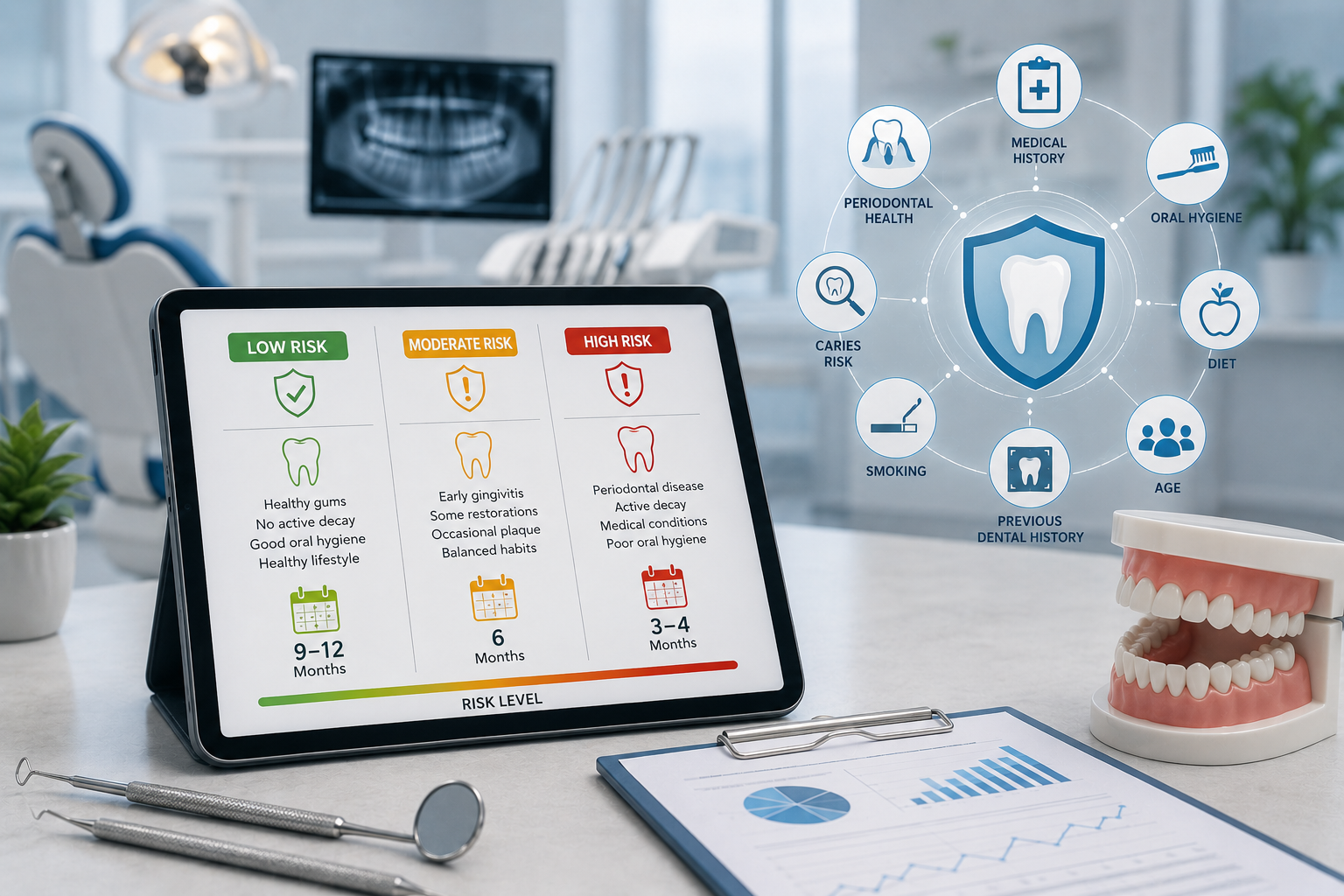
Dentists evaluate:
- Caries risk
- Periodontal health
- Medical conditions
- Tobacco use
- Oral hygiene habits
- Dietary patterns
- Previous dental history
- Age
- Saliva flow
- Restorative status
Each factor contributes to determining the patient’s future disease risk.
Low-Risk Patients
Low-risk patients typically demonstrate:
- Excellent oral hygiene
- No active decay
- Healthy gums
- Minimal restorations
- Regular dental attendance
- Healthy lifestyle habits
These patients may benefit from recall intervals of 9 to 12 months, depending on clinical judgment and local guidelines.
Reducing unnecessary appointments also allows practices to allocate more time to higher-risk individuals.
Moderate-Risk Patients
Moderate-risk patients may present with:
- Occasional plaque accumulation
- Early gingivitis
- Several restorations
- History of treated caries
- Mild dietary concerns
These patients commonly benefit from recall visits every six months, combined with preventive education and professional cleaning.
Their recall interval may be adjusted if risk factors improve or worsen.
High-Risk Patients
High-risk patients often require significantly closer monitoring.
Common risk factors include:
- Active dental caries
- Periodontal disease
- Diabetes
- Xerostomia
- Smoking
- Orthodontic appliances
- High sugar consumption
- Poor oral hygiene
- Previous tooth loss
These individuals may require recalls every three to four months to detect disease progression early and reinforce preventive care.
Frequent maintenance often reduces the need for extensive restorative treatment later.
Specialty Practices and Risk-Based Scheduling
Risk-based recall scheduling is equally valuable across dental specialties.
Periodontics
Patients with periodontal disease often benefit from individualized periodontal maintenance programs.
Recall intervals may vary depending on:
- Pocket depth
- Bleeding on probing
- Plaque control
- Smoking status
- Systemic health
Regular maintenance helps reduce disease recurrence and supports long-term tooth retention.
Implant Dentistry
Dental implants require lifelong monitoring.
Recall appointments typically focus on:
- Peri-implant tissue health
- Bone stability
- Prosthetic integrity
- Oral hygiene
- Occlusion
Patients with multiple implants or previous peri-implantitis may require shorter recall intervals.
Pediatric Dentistry
Children require individualized preventive programs based on:
- Caries risk
- Fluoride exposure
- Dietary habits
- Oral hygiene
- Tooth eruption patterns
High-risk children often benefit from recalls every three to four months, while low-risk children may be reviewed less frequently.
Orthodontics
Patients undergoing orthodontic treatment require regular monitoring of:
- Oral hygiene
- Appliance condition
- Gingival health
- Tooth movement
- Caries risk
Preventive recall visits support both orthodontic success and long-term oral health.
Using Technology to Assess Risk
Modern dental software increasingly supports risk-based scheduling.
Practice management systems now integrate:
- Digital health records
- Caries risk assessment tools
- Periodontal charting
- AI-assisted diagnostics
- Automated recall reminders
These technologies help clinicians make evidence-based decisions while improving consistency across the practice.
Artificial Intelligence may also assist in identifying patients whose risk profile changes over time.
Communicating Recall Decisions to Patients
Patients are accustomed to hearing that they should visit the dentist every six months.
When implementing personalized recall schedules, effective communication is essential.
Rather than presenting the interval as arbitrary, dentists should explain:
- Individual risk factors
- Current oral health status
- Preventive goals
- Benefits of personalized care
Patients are more likely to accept customized recall intervals when they understand the clinical reasoning behind the recommendation.
Benefits for Dental Practices
Risk-based recall scheduling benefits not only patients but also dental practices.
Advantages include:
- Better preventive outcomes
- Improved patient satisfaction
- More efficient appointment utilization
- Reduced emergency visits
- Higher clinical productivity
- Enhanced evidence-based care
- Stronger patient relationships
Practices can allocate clinical resources more effectively by focusing attention where it is needed most.
Challenges to Implementation
Transitioning from fixed recall schedules to personalized care requires planning.
Practices should consider:
- Staff training
- Standardized risk assessment protocols
- Updated practice management software
- Patient education
- Documentation procedures
Consistency among clinicians is essential to ensure that recall recommendations remain evidence-based and transparent.
The Future of Personalized Preventive Dentistry
As AI, digital diagnostics, and predictive analytics continue advancing, recall scheduling will become even more personalized.
Future systems may automatically recommend recall intervals by analyzing:
- Clinical findings
- Radiographic changes
- Medical updates
- Behavioral patterns
- Previous treatment outcomes
This data-driven approach has the potential to improve preventive care while reducing unnecessary appointments. The future of dentistry is moving from time-based care to risk-based care.Preventive dentistry has evolved far beyond the traditional six-month recall appointment. In 2026, forward-thinking dental practices are adopting risk-based recall scheduling, a personalized approach that tailors maintenance visits according to each patient’s oral health status, lifestyle, medical history, and individual risk factors.
Instead of applying the same recall interval to every patient, dentists now use evidence-based assessments to determine how frequently each patient should be seen. This strategy improves preventive care, enhances patient outcomes, optimizes clinical resources, and supports value-based dentistry.
According to preventive care trends highlighted by DenTrends, risk-based recall scheduling is becoming an essential component of modern dental practice management, helping clinicians deliver more personalized and proactive care.
What Is Risk-Based Recall Scheduling?
Risk-based recall scheduling is a preventive care model where recall intervals are determined by an individual patient’s risk of developing oral diseases rather than by a fixed calendar schedule.
Rather than recommending every patient return every six months, dentists evaluate multiple clinical and behavioral factors to decide whether a patient should be reviewed after three months, six months, nine months, or even twelve months.
The goal is simple:
Provide the right level of preventive care at the right time for the right patient.
Why the Traditional Six-Month Recall Is Changing
For decades, the six-month dental check-up has been the standard recommendation.
While this schedule remains appropriate for many patients, research has shown that oral health risks vary significantly between individuals.
For example:
- A healthy adult with excellent oral hygiene may not require frequent recalls.
- A diabetic patient with active periodontal disease may benefit from three-month maintenance visits.
- A patient undergoing orthodontic treatment may require more frequent monitoring.
- An implant patient may need customized peri-implant maintenance.
Modern dentistry recognizes that one recall schedule does not fit everyone.
The Core Principles of Risk-Based Care
Risk-based scheduling begins with a comprehensive patient assessment.
Dentists evaluate:
- Caries risk
- Periodontal health
- Medical conditions
- Tobacco use
- Oral hygiene habits
- Dietary patterns
- Previous dental history
- Age
- Saliva flow
- Restorative status
Each factor contributes to determining the patient’s future disease risk.
Low-Risk Patients
Low-risk patients typically demonstrate:
- Excellent oral hygiene
- No active decay
- Healthy gums
- Minimal restorations
- Regular dental attendance
- Healthy lifestyle habits
These patients may benefit from recall intervals of 9 to 12 months, depending on clinical judgment and local guidelines.
Reducing unnecessary appointments also allows practices to allocate more time to higher-risk individuals.
Moderate-Risk Patients
Moderate-risk patients may present with:
- Occasional plaque accumulation
- Early gingivitis
- Several restorations
- History of treated caries
- Mild dietary concerns
These patients commonly benefit from recall visits every six months, combined with preventive education and professional cleaning.
Their recall interval may be adjusted if risk factors improve or worsen.
High-Risk Patients
High-risk patients often require significantly closer monitoring.
Common risk factors include:
- Active dental caries
- Periodontal disease
- Diabetes
- Xerostomia
- Smoking
- Orthodontic appliances
- High sugar consumption
- Poor oral hygiene
- Previous tooth loss
These individuals may require recalls every three to four months to detect disease progression early and reinforce preventive care.
Frequent maintenance often reduces the need for extensive restorative treatment later.
Specialty Practices and Risk-Based Scheduling
Risk-based recall scheduling is equally valuable across dental specialties.
Periodontics
Patients with periodontal disease often benefit from individualized periodontal maintenance programs.
Recall intervals may vary depending on:
- Pocket depth
- Bleeding on probing
- Plaque control
- Smoking status
- Systemic health
Regular maintenance helps reduce disease recurrence and supports long-term tooth retention.
Implant Dentistry
Dental implants require lifelong monitoring.
Recall appointments typically focus on:
- Peri-implant tissue health
- Bone stability
- Prosthetic integrity
- Oral hygiene
- Occlusion
Patients with multiple implants or previous peri-implantitis may require shorter recall intervals.
Pediatric Dentistry
Children require individualized preventive programs based on:
- Caries risk
- Fluoride exposure
- Dietary habits
- Oral hygiene
- Tooth eruption patterns
High-risk children often benefit from recalls every three to four months, while low-risk children may be reviewed less frequently.
Orthodontics
Patients undergoing orthodontic treatment require regular monitoring of:
- Oral hygiene
- Appliance condition
- Gingival health
- Tooth movement
- Caries risk
Preventive recall visits support both orthodontic success and long-term oral health.
Using Technology to Assess Risk
Modern dental software increasingly supports risk-based scheduling.
Practice management systems now integrate:
- Digital health records
- Caries risk assessment tools
- Periodontal charting
- AI-assisted diagnostics
- Automated recall reminders
These technologies help clinicians make evidence-based decisions while improving consistency across the practice.
Artificial Intelligence may also assist in identifying patients whose risk profile changes over time.
Communicating Recall Decisions to Patients
Patients are accustomed to hearing that they should visit the dentist every six months.
When implementing personalized recall schedules, effective communication is essential.
Rather than presenting the interval as arbitrary, dentists should explain:
- Individual risk factors
- Current oral health status
- Preventive goals
- Benefits of personalized care
Patients are more likely to accept customized recall intervals when they understand the clinical reasoning behind the recommendation.
Benefits for Dental Practices
Risk-based recall scheduling benefits not only patients but also dental practices.
Advantages include:
- Better preventive outcomes
- Improved patient satisfaction
- More efficient appointment utilization
- Reduced emergency visits
- Higher clinical productivity
- Enhanced evidence-based care
- Stronger patient relationships
Practices can allocate clinical resources more effectively by focusing attention where it is needed most.
Challenges to Implementation
Transitioning from fixed recall schedules to personalized care requires planning.
Practices should consider:
- Staff training
- Standardized risk assessment protocols
- Updated practice management software
- Patient education
- Documentation procedures
Consistency among clinicians is essential to ensure that recall recommendations remain evidence-based and transparent.
The Future of Personalized Preventive Dentistry
As AI, digital diagnostics, and predictive analytics continue advancing, recall scheduling will become even more personalized.
Future systems may automatically recommend recall intervals by analyzing:
- Clinical findings
- Radiographic changes
- Medical updates
- Behavioral patterns
- Previous treatment outcomes
This data-driven approach has the potential to improve preventive care while reducing unnecessary appointments. The future of dentistry is moving from time-based care to risk-based care.
DenTrends Thoughts
Risk-based recall scheduling represents one of the most practical and impactful changes in modern preventive dentistry.
By tailoring maintenance appointments to each patient’s individual needs, dentists can detect disease earlier, improve treatment outcomes, optimize clinical resources, and deliver more personalized care.
Whether in general practice, periodontics, implantology, pediatric dentistry, or orthodontics, individualized recall programs are helping shift dentistry from a reactive model to a proactive, prevention-focused profession.
As digital technologies and AI continue to support clinical decision-making, personalized recall scheduling is likely to become the standard of care for practices committed to delivering evidence-based, patient-centered dentistry..
References
- National Institute for Health and Care Excellence (NICE) – Dental Recall: Recall Interval Between Routine Dental Examinations
https://www.nice.org.uk/guidance/cg19 - American Dental Association (ADA) – Caries Risk Assessment and Preventive Care
https://www.ada.org - American Academy of Periodontology (AAP) – Periodontal Maintenance
https://www.perio.org - Centers for Disease Control and Prevention (CDC) – Adult Oral Health
https://www.cdc.gov/oralhealth - Journal of Dental Research
https://journals.sagepub.com/home/jdr - British Society of Periodontology – S3 Clinical Practice Guidelines
https://www.bsperio.org.uk
Use up and down arrow keys to resize the meta box pane.