

The rise of Dental Service Organizations (DSOs) is transforming the dental industry faster than almost any other trend in modern dentistry.
Across the United States, corporate dental groups are expanding aggressively:
- Acquiring practices
- Opening multi-location clinics
- Investing heavily in technology
- Recruiting young dentists
- Standardizing operations at scale
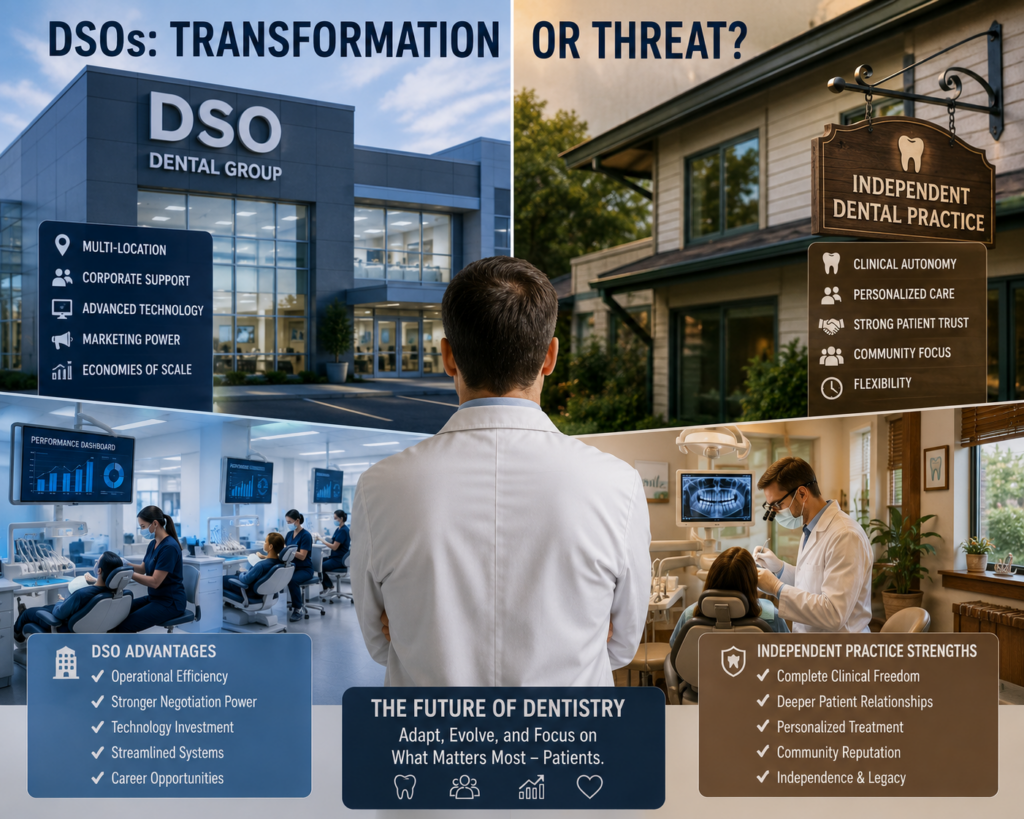
For some dentists, DSOs represent efficiency, modernization, and business stability.
For others, they symbolize something far more concerning:
The corporatization of healthcare.
This has sparked one of the biggest debates in dentistry today:
Are DSOs destroying independent dentistry?
The answer is complex.
DSOs are not simply “good” or “bad.”
They are reshaping dentistry economically, culturally, operationally, and psychologically — and the effects are being felt across the entire profession.
What Is a DSO?
A Dental Service Organization (DSO) is a company that manages the non-clinical business side of dental practices.
DSOs typically handle:
- Marketing
- HR
- Billing
- Payroll
- Insurance administration
- Technology systems
- Procurement
- Compliance
- Expansion strategy
Meanwhile, dentists focus primarily on clinical care.
Major DSO brands include:
- Aspen Dental
- Heartland Dental
- Pacific Dental Services
The DSO model has grown rapidly over the past decade. (ada.org)
Why DSOs Are Growing So Fast
The growth is not accidental.
Several major industry pressures created the perfect environment for DSO expansion.
1. Rising Costs of Running a Practice
Modern dentistry has become extremely expensive.
Independent dentists face increasing costs for:
- Staff salaries
- Hygiene wages
- Technology upgrades
- Rent
- Compliance
- Insurance administration
- Marketing
- Software subscriptions
DSOs benefit from economies of scale.
They can negotiate:
- Better supply pricing
- Equipment discounts
- Marketing efficiency
- Centralized administrative systems
This gives them major operational advantages.
2. Younger Dentists Often Prefer Stability
Many newer dentists graduate with:
- Large student debt
- Limited business training
- Fear of ownership risk
DSOs offer:
- Immediate employment
- Benefits
- Predictable income
- Reduced management stress
- Faster career entry
For some younger dentists, ownership feels financially overwhelming.
According to industry data, younger graduates increasingly consider DSO employment early in their careers. (adanews.ada.org)
3. Administrative Complexity Keeps Increasing
Modern dentistry now involves enormous operational complexity:
- Insurance claims
- Cybersecurity
- HIPAA compliance
- Staffing management
- Digital systems
- Reputation management
Many independent dentists feel exhausted by non-clinical responsibilities.
DSOs remove much of that burden.
This is one reason some dentists view DSOs as practical survival solutions rather than threats.
Why Independent Dentists Feel Threatened
Despite the advantages, many private practice owners are deeply concerned.
The fear is not only financial —
it is philosophical.
1. Loss of Clinical Autonomy
This is one of the biggest concerns.
Some dentists worry that corporate systems prioritize:
- Production goals
- Revenue metrics
- Efficiency targets
over individualized patient care.
Critics argue that aggressive performance expectations may influence:
- Treatment recommendations
- Scheduling pressure
- Case acceptance strategies
Many independent dentists fear:
Dentistry could become more business-driven than patient-driven.
2. High-Volume Dentistry Concerns
DSOs often rely on scale and operational efficiency.
This may create:
- Shorter appointments
- Faster patient turnover
- Increased production pressure
Some dentists believe this environment contributes to:
- Burnout
- Reduced patient relationships
- Lower personalization
Not all DSOs operate this way —
but the perception is widespread.
3. Independent Practices Struggle to Compete
Large corporate groups can invest heavily in:
- Advertising
- SEO
- Technology
- AI systems
- Staffing incentives
- Prime locations
Smaller practices often cannot match those budgets.
This creates fear that independent clinics may slowly disappear in some markets.
Especially vulnerable are:
- Solo practices
- Rural clinics
- Older dentists nearing retirement
4. Rising Practice Acquisitions
Many independent dentists are selling practices to DSOs.
Reasons include:
- Retirement
- Financial pressure
- Staffing difficulties
- Desire to reduce stress
- Attractive acquisition offers
This accelerates industry consolidation.
Some experts believe dentistry is following a path similar to:
- Corporate medicine
- Pharmacy chains
- Private equity healthcare expansion
Are DSOs Actually Bad for Patients?
Not necessarily.
Many patients benefit from:
- Modern technology
- Extended office hours
- Multiple locations
- Standardized systems
- Faster scheduling
- Financing options
Some DSOs provide excellent patient experiences.
Large organizations also often invest in:
- Digital dentistry
- AI integration
- Staff training
- Operational consistency
The issue is not simply size —
it is how the model is implemented.
The Emotional Divide in Dentistry
The DSO debate is deeply emotional because dentistry has historically been built around:
- Personal relationships
- Community trust
- Independent ownership
- Professional autonomy
Many dentists dreamed of owning a private practice for decades.
Now some feel that dream is becoming harder to achieve.
This creates a cultural divide:
- Traditional ownership model
vs - Corporate scalability model
Are DSOs Hurting the Profession Financially?
The answer depends on perspective.
Critics argue DSOs may:
- Increase production pressure
- Lower reimbursement expectations
- Normalize high-volume dentistry
- Shift power toward corporations
Supporters argue DSOs:
- Improve efficiency
- Reduce business stress
- Modernize operations
- Help practices survive economically
Both perspectives contain truth.
The Staffing Advantage DSOs Have
One major reason DSOs continue growing is hiring power.
Large organizations can often offer:
- Higher salaries
- Signing bonuses
- Benefits
- Structured career growth
- Multi-location flexibility
Independent practices increasingly struggle to compete during staffing shortages.
This is especially important in 2026 because:
The dental workforce crisis is worsening nationwide.
Technology Is Accelerating the Gap
DSOs are investing aggressively in:
- AI diagnostics
- Cloud systems
- Centralized analytics
- Automated workflows
- Digital marketing
Technology adoption requires capital.
Independent practices that fail to modernize may fall behind operationally.
However, smaller practices still possess unique advantages:
- Personalized relationships
- Community reputation
- Flexibility
- Patient trust
- Boutique experiences
Can Independent Dentistry Survive?
Absolutely — but the model is evolving.
Independent practices that succeed in 2026 often focus on:
- Exceptional patient experience
- Strong branding
- Niche specialization
- Cosmetic dentistry
- Advanced technology
- Membership plans
- Community trust
- High-touch care
The future may involve fewer “generic” independent clinics and more specialized, experience-driven practices.
What Patients Really Want
Most patients ultimately prioritize:
- Trust
- Convenience
- Affordability
- Communication
- Comfort
- Reputation
Some patients prefer:
- Large modern clinics
Others prefer:
- Personalized private practices
There is room for both models.
The Bigger Reality: Dentistry Is Becoming a Business Ecosystem
This is the deeper truth behind the DSO expansion.
Dentistry is no longer only clinical care.
It now involves:
- Technology
- Marketing
- Data systems
- AI
- Financial management
- Workforce strategy
- Patient acquisition
DSOs adapted quickly to this new environment.
Independent dentists must adapt too.comes increasingly digital, smart clinics will continue to gain a strategic advantage through operational efficiency, improved diagnostics, enhanced patient experiences, and scalable practice management.
Final Thought
DSOs are not destroying independent dentistry entirely.
But they are absolutely transforming it.
The traditional solo-practice model faces more pressure than ever before from:
- Rising costs
- Staffing shortages
- Technology demands
- Insurance pressure
- Corporate competition
Some independent practices will disappear.
Others will evolve and thrive.
The future likely belongs to practices that combine:
- Clinical excellence
- Strong branding
- Technology adoption
- Exceptional patient relationships
Independent dentistry is not dying —
but it can no longer operate the same way it did 20 years ago.