
For decades, receiving a dental crown or restoration often meant multiple appointments, temporary restorations, physical impressions, and waiting several weeks for a dental laboratory to fabricate the final prosthesis. Today, advances in digital dentistry have fundamentally changed that process. In 2026, same-day 3D printed restorations are enabling dentists to diagnose, design, manufacture, and deliver highly accurate restorations in a single visit.
Powered by intraoral scanners, Artificial Intelligence (AI), CAD/CAM software, and next-generation dental 3D printers, this digital workflow is transforming restorative dentistry. Patients benefit from shorter treatment times, fewer appointments, and greater comfort, while clinicians enjoy improved precision, workflow efficiency, and enhanced patient satisfaction.
According to digital dentistry trends highlighted by DenTrends, same-day 3D printed restorations represent one of the most significant innovations shaping the future of restorative and prosthetic dentistry.
What Are Same-Day 3D Printed Restorations?
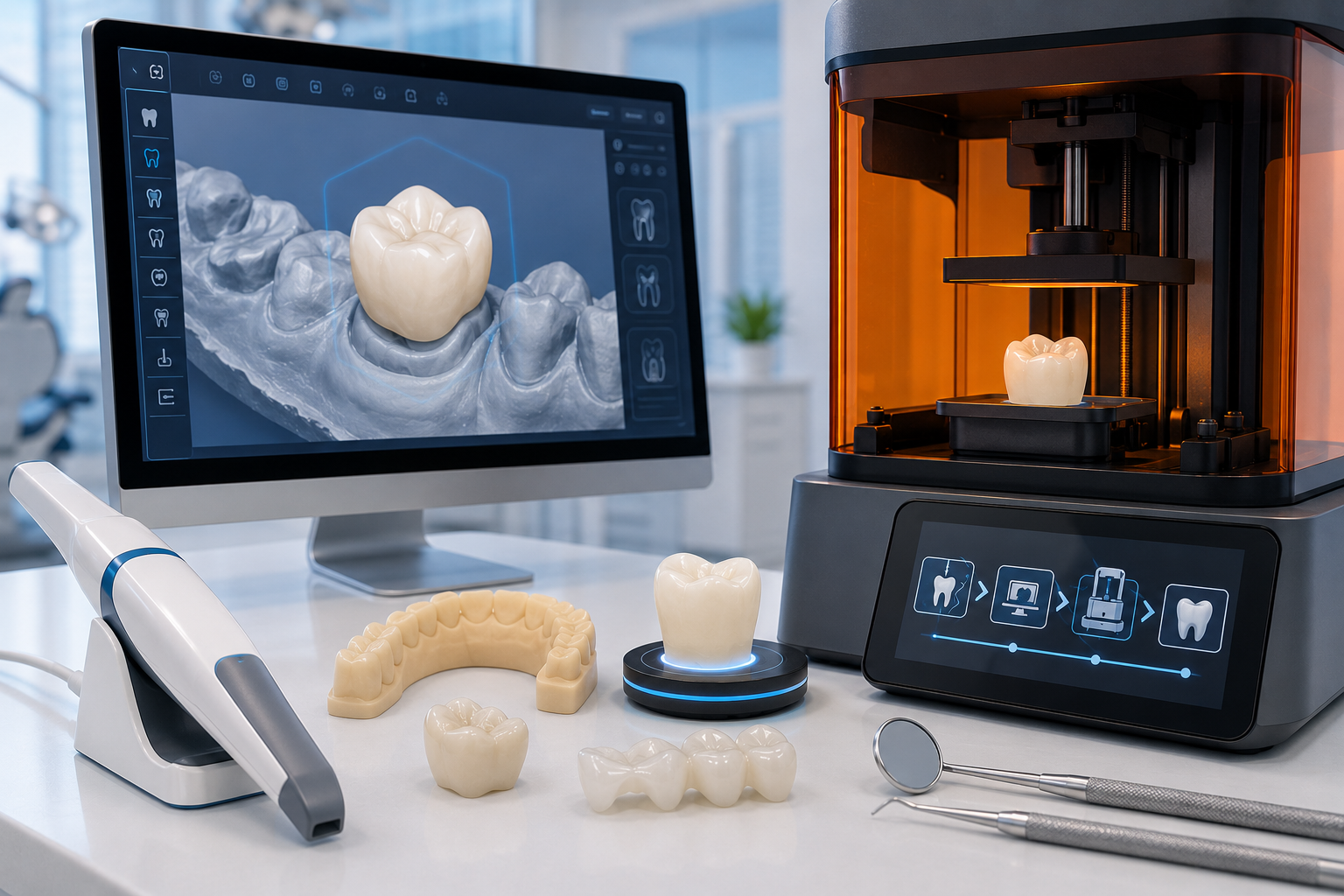
Same-day 3D printed restorations are dental prostheses that are digitally designed and manufactured within the dental clinic or an associated laboratory during a single appointment.
Using advanced digital technologies, dentists can produce temporary and, increasingly, definitive restorations such as:
- Crowns
- Bridges
- Veneers
- Inlays
- Onlays
- Surgical guides
- Temporary dentures
- Implant provisionals
- Occlusal splints
- Orthodontic models
The entire process is completed digitally without traditional impression materials.
The Digital Workflow
The success of same-day restorations depends on a fully integrated digital workflow.
Step 1: Digital Consultation
The appointment begins with a comprehensive examination and digital diagnosis.
The dentist evaluates:
- Tooth condition
- Occlusion
- Smile aesthetics
- Restorative requirements
- Digital photographs
- Radiographs
- CBCT imaging (when required)
Digital records become the foundation for treatment planning.
Step 2: Intraoral Scanning
Traditional impressions have largely been replaced by high-speed intraoral scanners.
These scanners create an accurate three-dimensional model of the patient’s teeth within minutes.
Benefits include:
- Improved patient comfort
- Greater accuracy
- Faster workflow
- Immediate digital records
Popular scanners include systems from 3Shape, iTero, Medit, DEXIS, and CEREC.
Step 3: AI-Assisted Restoration Design
Modern CAD software increasingly incorporates Artificial Intelligence to assist with restoration design.
AI helps optimize:
- Tooth morphology
- Occlusal contacts
- Marginal adaptation
- Proximal contacts
- Functional anatomy
Rather than replacing the dentist or dental technician, AI accelerates design while maintaining clinical oversight.
Step 4: CAD Design
Using CAD (Computer-Aided Design) software, the restoration is digitally designed according to the patient’s anatomy.
The dentist can modify:
- Shape
- Size
- Contours
- Occlusion
- Contact points
- Aesthetics
Patients may even preview their restoration before manufacturing begins.
Step 5: 3D Printing
The digital file is transferred directly to a dental 3D printer.
Modern printers use highly accurate resin technologies capable of producing restorations with exceptional precision.
Current applications include:
- Temporary crowns
- Long-term provisional restorations
- Implant provisionals
- Denture bases
- Surgical guides
- Orthodontic appliances
Printing typically requires between 15 and 45 minutes, depending on the restoration type.
Step 6: Post-Processing
After printing, restorations undergo:
- Cleaning
- Light curing
- Polishing
- Characterization
- Final finishing
Some definitive restorations may require additional glazing or laboratory processing depending on the material used.
Step 7: Delivery
The restoration is tried in, adjusted if necessary, and bonded or cemented during the same appointment.
Patients leave the clinic with their completed restoration rather than wearing temporary crowns for several weeks.
Benefits for Patients
Same-day 3D printed restorations offer numerous advantages.
Patients experience:
- Fewer appointments
- No messy impressions
- Immediate treatment
- Greater comfort
- Reduced anxiety
- Faster recovery
- Improved aesthetics
- Digital precision
For busy professionals and international dental tourists, same-day treatment significantly reduces travel and time away from work.
Benefits for Dentists
Digital workflows also improve clinical efficiency.
Practices benefit from:
- Faster case completion
- Reduced laboratory turnaround
- Lower impression errors
- Improved communication
- Better patient acceptance
- Digital case storage
- Increased productivity
- Enhanced treatment predictability
Same-day dentistry allows practices to deliver premium patient experiences while optimizing chair time.
Materials Used in 3D Printing
Modern dental 3D printers utilize specialized biocompatible materials designed for various clinical applications.
Common materials include:
- Temporary crown resin
- Permanent crown resin (selected indications)
- Denture resin
- Surgical guide resin
- Splint resin
- Gingival mask resin
- Castable resin
Material science continues to advance rapidly, expanding the range of definitive restorations that can be printed safely and accurately.
Leading 3D Printing Systems
Several manufacturers are leading innovation in dental 3D printing.
Popular platforms include:
- Formlabs Dental
- SprintRay
- Asiga
- NextDent
- Ackuretta
- Carbon
- Stratasys Dental
These systems integrate with digital scanners and CAD software to create seamless restorative workflows.
AI Is Making 3D Printing Smarter
Artificial Intelligence is enhancing every stage of the workflow.
AI now assists with:
- Margin detection
- Restoration design
- Occlusal optimization
- Print orientation
- Quality control
- Workflow automation
Future AI systems may automatically generate restorations based on patient anatomy with minimal manual adjustment.
Applications Beyond Crowns
3D printing extends far beyond single-tooth restorations.
Modern dental practices also print:
- Implant surgical guides
- Clear aligner models
- Occlusal guards
- Digital dentures
- Provisional implant bridges
- Orthodontic retainers
- Diagnostic wax-ups
- Educational models
This versatility makes 3D printing one of the most valuable technologies in digital dentistry.
Challenges and Limitations
Despite rapid progress, certain challenges remain.
Clinicians should consider:
- Initial equipment investment
- Material costs
- Staff training
- Printer maintenance
- Material limitations
- Regulatory compliance
- Long-term clinical validation for some printed permanent restorations
For many definitive ceramic restorations, milling technologies continue to play an important role alongside 3D printing.
The future is likely to combine both additive and subtractive manufacturing depending on the clinical situation.
The Future of Same-Day Restorative Dentistry
Researchers continue developing stronger printable ceramics, hybrid materials, and AI-driven manufacturing systems.
Future innovations may include:
- Fully printed permanent ceramic crowns
- Multi-material printing
- AI-generated restoration designs
- Automated finishing
- Chairside robotic production
- Personalized biomaterials
These advances promise even faster workflows and greater clinical precision.
DenTrends Thoughts
Same-day 3D printed restorations are transforming restorative dentistry by combining digital scanning, AI-assisted design, CAD software, and advanced additive manufacturing into a seamless clinical workflow.
Patients benefit from faster treatment, improved comfort, and fewer appointments, while dentists gain greater efficiency, precision, and treatment predictability.
As printable materials continue to evolve and AI becomes more integrated into restorative workflows, same-day digital dentistry will become increasingly accessible across general practice, prosthodontics, implantology, and cosmetic dentistry.
The future of restorative dentistry is no longer measured in weeks—it is measured in hours.
References
- Formlabs Dental – Digital Dentistry Solutions
https://dental.formlabs.com - SprintRay – Chairside 3D Printing
https://sprintray.com - 3Shape – Digital Dentistry Workflow
https://www.3shape.com - Journal of Prosthetic Dentistry
https://www.thejpd.org - Journal of Prosthodontics
https://onlinelibrary.wiley.com/journal/1532849x - American College of Prosthodontists (ACP)
https://www.prosthodontics.org - International Journal of Computerized Dentistry
https://www.quintessence-publishing.com