
The modern dental clinic is more connected than ever before. Electronic health records, cloud-based practice management systems, digital imaging, intraoral scanners, Artificial Intelligence (AI), online appointment scheduling, and remote patient communication have transformed the way dental professionals deliver care. While these technologies improve efficiency and patient experience, they also expose dental practices to increasing cybersecurity threats.
Cybercriminals no longer target only large hospitals or multinational corporations. Small and mid-sized dental clinics have become attractive targets because they store highly valuable patient information but often have fewer cybersecurity resources than larger healthcare organizations.
In 2026, cybersecurity is no longer just an IT issue—it is an essential part of clinical practice management and patient safety.
According to technology and practice management trends featured by DenTrends, protecting digital infrastructure has become just as important as maintaining sterilization protocols or complying with infection control standards.
Why Dental Clinics Are Attractive Targets
A dental practice stores a surprising amount of sensitive information.
Digital systems may contain:
- Patient names and addresses
- Medical and dental histories
- X-rays and CBCT scans
- Insurance information
- Payment details
- Driver’s license or identification records
- Employee payroll data
- Prescription information
- Clinical photographs
Unlike credit card numbers, healthcare records cannot simply be replaced after a breach. They often contain lifelong personal information, making them highly valuable to cybercriminals.
The Growing Digital Transformation
Modern dental clinics rely on numerous interconnected technologies.
These include:
- Cloud-based practice management software
- Digital radiography
- AI-powered diagnostics
- Electronic prescriptions
- Online patient portals
- Intraoral scanners
- Digital Smile Design platforms
- Email communication
- Tele-dentistry
- Third-party laboratory integrations
Each connected system increases efficiency—but also creates another potential point of entry for attackers.
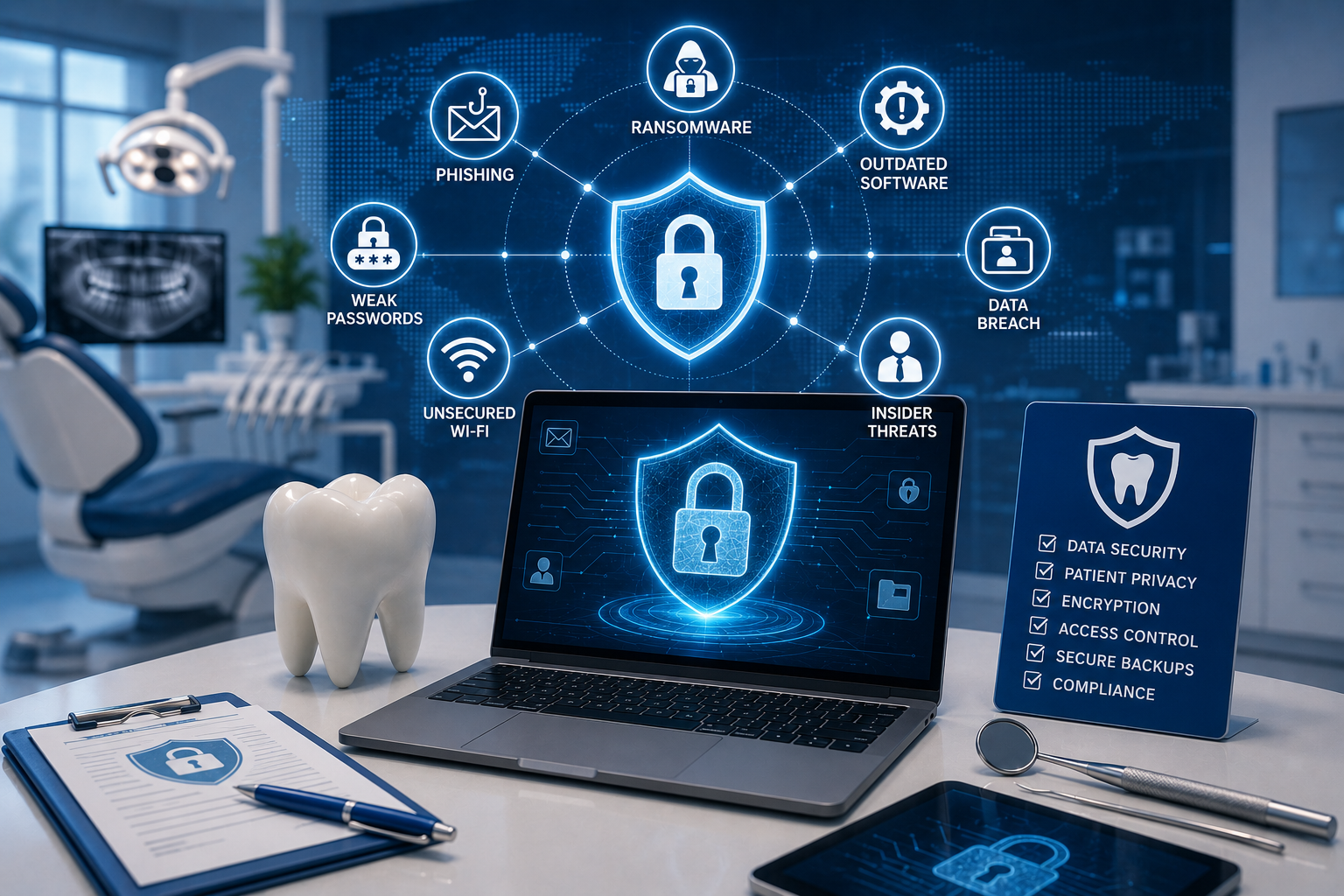
1. Ransomware Attacks
Ransomware has become one of the most serious cybersecurity threats in healthcare.
Attackers encrypt clinic data and demand payment before restoring access.
A ransomware attack can disable:
- Appointment schedules
- Patient records
- Imaging systems
- Billing software
- Practice management platforms
Without access to these systems, many clinics are forced to postpone treatment until data can be recovered.
Regular offline backups and tested recovery plans are essential defenses against ransomware.
2. Phishing Emails
Phishing remains one of the most common causes of data breaches.
Cybercriminals create emails that appear to come from:
- Insurance providers
- Dental suppliers
- Banks
- Software vendors
- Government agencies
Staff may unknowingly click malicious links or provide login credentials.
Regular staff awareness training significantly reduces phishing success.
3. Weak Passwords
Simple or reused passwords continue to expose many dental practices to unnecessary risk.
Examples include:
- Clinic123
- Password123
- Admin123
Strong password policies should include:
- Long, unique passwords
- Password managers
- Multi-factor authentication (MFA)
- Regular password updates
Protecting user accounts is one of the simplest and most effective cybersecurity measures.
4. Unsecured Wi-Fi Networks
Many clinics provide guest Wi-Fi for patients.
If guest networks are not separated from internal systems, attackers may gain access to business devices.
Dental practices should maintain:
- Separate guest Wi-Fi
- Encrypted wireless networks
- Secure router configurations
- Regular firmware updates
Network segmentation limits the spread of cyber threats.
5. Outdated Software
Older software often contains security vulnerabilities that cybercriminals actively exploit.
This includes:
- Operating systems
- Practice management software
- Imaging applications
- Antivirus programs
- Firewalls
Routine software updates help close known security gaps before attackers can exploit them.
6. Cloud Security Risks
Cloud-based systems offer tremendous flexibility but require proper configuration.
Important considerations include:
- Data encryption
- Secure authentication
- User access controls
- Audit logs
- Vendor security certifications
- Regular backups
Choosing reputable cloud providers with healthcare compliance experience is essential.
7. Insider Threats
Not every cybersecurity incident comes from external hackers.
Risks may arise from:
- Former employees
- Shared login credentials
- Accidental data deletion
- Unauthorized access
- Poor access management
Role-based permissions help ensure employees access only the information necessary for their responsibilities.
8. Third-Party Vendor Vulnerabilities
Dental practices often connect with:
- Laboratories
- Insurance companies
- Payment processors
- Software vendors
- Imaging providers
A weakness in one third-party system may expose the entire practice.
Vendor cybersecurity assessments should become part of purchasing decisions.
9. Mobile Device Security
Dentists increasingly access patient records using:
- Smartphones
- Tablets
- Laptops
Lost or stolen devices can create major security risks if they lack:
- Encryption
- Password protection
- Remote wipe capability
- Device management software
Mobile security should be included in every cybersecurity policy.
10. Artificial Intelligence and Cybersecurity
AI creates both opportunities and challenges.
AI helps improve cybersecurity through:
- Threat detection
- Network monitoring
- Suspicious login alerts
- Automated risk analysis
However, cybercriminals also use AI to produce:
- More convincing phishing emails
- Automated malware
- Deepfake communications
- Credential attacks
As AI evolves, cybersecurity strategies must evolve alongside it.
Best Practices for Dental Clinics
Every dental practice should establish a cybersecurity program that includes:
- Multi-factor authentication
- Strong password policies
- Encrypted data storage
- Automatic software updates
- Daily backups
- Secure cloud platforms
- Employee cybersecurity training
- Antivirus and endpoint protection
- Firewall monitoring
- Regular security audits
Cybersecurity should become part of everyday clinic operations rather than an occasional IT project.
Building a Cybersecurity Culture
Technology alone cannot eliminate cyber risks.
Every member of the dental team plays a role in protecting patient information.
Practices should encourage staff to:
- Verify suspicious emails
- Report unusual activity immediately
- Avoid sharing passwords
- Lock computers when unattended
- Follow established security policies
Creating a culture of awareness significantly reduces human error.
The Future of Cybersecurity in Dentistry
Cybersecurity will become increasingly integrated into digital dentistry.
Future innovations may include:
- AI-driven threat detection
- Zero-trust network architecture
- Biometric authentication
- Blockchain-secured health records
- Automated compliance monitoring
- Advanced cloud encryption
- Real-time cybersecurity dashboards
As dental practices continue adopting AI, cloud platforms, and connected devices, cybersecurity will remain a critical component of modern healthcare delivery.
DenTrends Thoughts
Digital transformation has brought tremendous benefits to dentistry, improving diagnosis, communication, workflow efficiency, and patient care. However, it has also introduced new cybersecurity challenges that every dental practice must address.
Protecting patient information requires more than antivirus software. It demands a comprehensive strategy that combines secure technology, well-trained staff, responsible leadership, and continuous monitoring.
By investing in cybersecurity today, dental clinics can protect patient trust, maintain business continuity, comply with healthcare regulations, and confidently embrace the future of digital dentistry.
In 2026, safeguarding data is just as important as safeguarding oral health.
References
- American Dental Association (ADA) – Cybersecurity Resources
https://www.ada.org - U.S. Cybersecurity and Infrastructure Security Agency (CISA)
https://www.cisa.gov - U.S. Department of Health & Human Services (HHS) – Health Industry Cybersecurity Practices
https://405d.hhs.gov - National Institute of Standards and Technology (NIST) Cybersecurity Framework
https://www.nist.gov/cyberframework - Health Sector Coordinating Council (HSCC)
https://healthsectorcouncil.org - HIPAA Journal – Healthcare Cybersecurity News
https://www.hipaajournal.com