
For decades, fluoride has been considered the gold standard for preventing tooth decay and strengthening enamel. However, a naturally occurring mineral called hydroxyapatite is rapidly gaining attention among dentists, researchers, and oral healthcare professionals as a promising biomimetic alternative for enamel repair and remineralization.
Hydroxyapatite is not a new discovery. In fact, it is the primary mineral that makes up nearly 97% of tooth enamel and approximately 70% of human bone, making it one of the most biologically compatible materials used in modern oral care. As research into preventive dentistry continues to expand, hydroxyapatite-based toothpastes are becoming increasingly popular for their ability to repair microscopic enamel defects, reduce sensitivity, and support long-term oral health.
What Is Hydroxyapatite?
Hydroxyapatite (Ca₁₀(PO₄)₆(OH)₂) is a naturally occurring calcium phosphate mineral found in human teeth and bones. Because tooth enamel is largely composed of hydroxyapatite crystals, scientists have explored its ability to restore minerals lost during the early stages of tooth decay.
Unlike abrasive whitening ingredients that simply polish the tooth surface, hydroxyapatite works by integrating with enamel and helping rebuild weakened areas through a process known as remineralization.
This biomimetic approach closely mimics the body’s natural repair mechanism and represents a major shift toward minimally invasive dentistry.
How Hydroxyapatite Protects Teeth
Every day, our teeth undergo cycles of demineralization and remineralization.
Acids produced by oral bacteria dissolve minerals from enamel after consuming sugary foods and drinks. If this mineral loss continues unchecked, it can eventually lead to cavities.
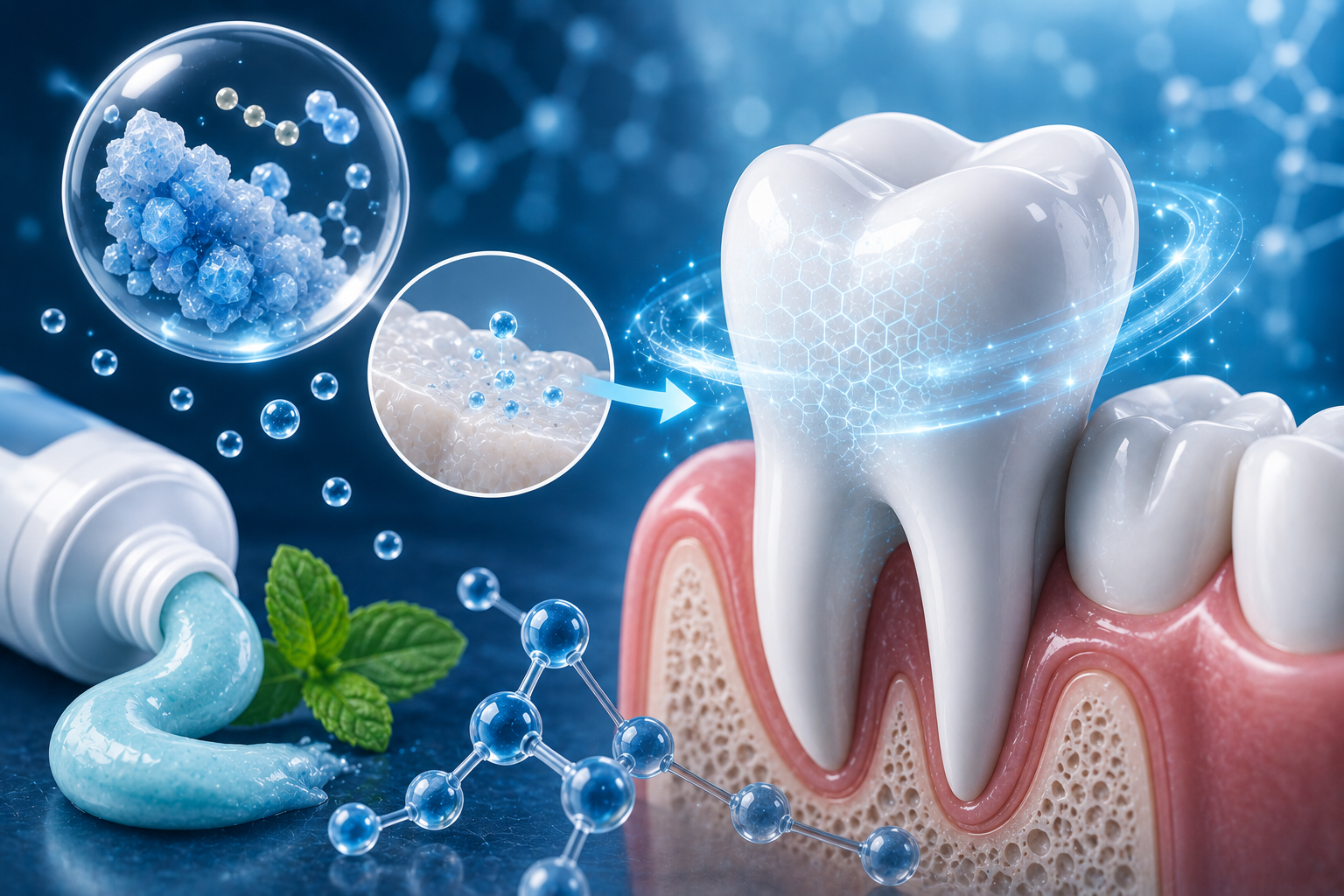
Hydroxyapatite toothpaste helps interrupt this process by supplying calcium and phosphate directly to weakened enamel surfaces. Nano-sized hydroxyapatite particles can penetrate microscopic defects, forming a protective layer that strengthens enamel and reduces sensitivity.
Research suggests that hydroxyapatite may:
- Rebuild early enamel lesions
- Support remineralization
- Reduce tooth sensitivity
- Protect against acid erosion
- Help prevent early-stage cavities
- Improve enamel smoothness
These properties make it an attractive option for preventive dentistry.
Can Hydroxyapatite Reverse Small Cavities?
One of the most discussed benefits of hydroxyapatite is its potential to repair early non-cavitated enamel lesions.
When decay is limited to mineral loss without a physical hole in the tooth, remineralization therapies may restore enamel integrity and halt disease progression.
However, once bacteria have created a visible cavity with structural breakdown, toothpaste alone cannot regenerate missing tooth structure. In these cases, professional restorative treatment remains necessary.
Therefore, hydroxyapatite should be viewed as an effective preventive and remineralizing agent rather than a replacement for dental care.
Hydroxyapatite vs Fluoride
The comparison between hydroxyapatite and fluoride has become increasingly common.
Fluoride works by promoting the formation of fluorapatite, a mineral that is more resistant to acid attack than natural enamel. It has decades of scientific evidence supporting its role in cavity prevention.
Hydroxyapatite, on the other hand, offers a biomimetic approach by replacing lost enamel minerals with the same material naturally found in teeth.
Rather than competing with fluoride, many experts believe hydroxyapatite can serve as an effective complementary or alternative option for individuals seeking fluoride-free oral care products.
Current research indicates promising results, but fluoride continues to have the strongest long-term evidence base for caries prevention.
A Technology Inspired by Space Research
One of the most fascinating aspects of hydroxyapatite toothpaste is its connection to space exploration.
During the 1970s, researchers working with NASA investigated synthetic hydroxyapatite as a way to help astronauts counter mineral loss experienced in microgravity environments. The technology was later licensed to the Japanese company Sangi, which developed one of the world’s first hydroxyapatite toothpastes under the Apadent brand.
Today, hydroxyapatite toothpaste is widely used in Japan and has become an established component of preventive oral care, with decades of clinical experience supporting its use.
Why Hydroxyapatite Is Growing in Popularity
Several trends are contributing to the rapid growth of hydroxyapatite-based oral care products.
Patients increasingly seek:
- Natural ingredients
- Minimally invasive prevention
- Sensitivity relief
- Enamel repair
- Fluoride alternatives
- Biomimetic oral care
At the same time, dentists are embracing preventive strategies that preserve healthy tooth structure rather than waiting for disease progression.
This philosophy aligns perfectly with the principles of modern minimally invasive dentistry.
What About Fang Farm Mint Toothpaste?
Among the newer generation of hydroxyapatite-based products, Fang Farm Mint Toothpaste has attracted attention for incorporating nano-hydroxyapatite alongside clean ingredient formulations.
The product is marketed as supporting:
- Enamel strengthening
- Daily remineralization
- Cavity prevention
- Fresh breath
- Tooth sensitivity reduction
While many hydroxyapatite-containing products demonstrate promising laboratory and clinical results, consumers should understand that overall oral health depends on multiple factors including brushing technique, diet, fluoride exposure where appropriate, regular professional dental examinations, and good oral hygiene habits.
No toothpaste alone can replace comprehensive dental care.
The Future of Preventive Dentistry
Hydroxyapatite represents one of the most exciting developments in preventive dentistry.
As researchers continue studying biomimetic materials, future oral care products may become even more effective at repairing microscopic enamel damage before invasive treatment becomes necessary.
Combined with artificial intelligence, digital diagnostics, and personalized preventive care, hydroxyapatite-based technologies may play a significant role in reducing the global burden of dental caries over the coming decades.
The future of dentistry is increasingly focused on preserving natural tooth structure—and hydroxyapatite is helping lead that transformation.
DenTrends Thoughts
Hydroxyapatite is much more than a trending toothpaste ingredient. As the primary mineral component of human enamel, it offers a scientifically grounded approach to strengthening teeth and supporting natural remineralization.
Although fluoride remains the most extensively studied anti-caries agent, hydroxyapatite has emerged as a promising biomimetic technology with growing clinical evidence and decades of successful use in Japan.
For patients interested in preventive oral care and enamel protection, hydroxyapatite-based toothpaste may become an important addition to a comprehensive dental health routine—always under the guidance of a dental professional.
References
- NASA Spinoff – Semiconductor Research Leads to a Revolution in Dental Care (explains the NASA origins of synthetic hydroxyapatite and its commercialization). (NASA Spinoff)
- The use of hydroxyapatite toothpaste to prevent dental caries (peer-reviewed review article describing NASA technology transfer and Sangi’s development of hydroxyapatite toothpaste). (PMC)
- Nano-hydroxyapatite and its applications in preventive, restorative and regenerative dentistry (comprehensive scientific review on remineralization and enamel repair). (PMC)
- Hydroxyapatite – overview of its role as the primary mineral component of teeth and its remineralization properties. (Wikipedia)
- SANGI Medical Hydroxyapatite – history of hydroxyapatite toothpaste development and approval in Japan. (株式会社サンギ 公式企業サイト)