
Why Every Modern Dental Practice Must Go Fully Digital
Dentistry is no longer just about drills and fillings. A quiet revolution has transformed clinics worldwide — powered by pixels, algorithms, and precision imaging. Digital Smile Design (DSD) stands at the forefront of this change, and practices that fully embrace it are moving far ahead of those still relying on analogue workflows.Key Industry Statistics
- 94% of patients prefer seeing a digital preview before undergoing cosmetic treatment.
- 3× higher case acceptance rates are reported in fully digital practices.
- 40% reduction in chair time is achieved using digital impressions compared to traditional methods.
- The global digital dentistry market is projected to reach $12 billion by 2028.
What Exactly Is Digital Smile Design?
Digital Smile Design is a multidisciplinary treatment planning concept that uses digital technologies — including photography, videography, CAD/CAM software, and 3D facial analysis — to design, communicate, and execute a patient’s ideal smile before any clinical procedure begins.
Originally introduced by Dr. Christian Coachman in 2007, DSD began as a presentation tool. Today, it has evolved into a comprehensive clinical protocol that connects aesthetics, function, and biology into a seamless digital workflow — from the initial consultation to final restoration.
Key Insight:
DSD is not a single piece of software or device. It is a philosophy of patient-centered, digitally driven treatment planning that integrates multiple technologies into one cohesive workflow.
Why “Partially Digital” Is No Longer Enough
Many practices have adopted individual digital tools — perhaps a CBCT scanner or an intraoral camera. However, a piecemeal approach creates disconnected systems and workflow bottlenecks. A fully digital practice integrates every stage of the patient journey into one connected ecosystem. The advantages are measurable — both clinically and financially.As digital dentistry specialist Dr. Marco Bernini notes: “The question is no longer whether to digitize your practice. It’s whether you can afford not to.”Patients today expect transparency, speed, and personalization — and digital workflows deliver all three.
Core Technologies Powering the Digital Practice
1. Intraoral Scanners (IOS)
Replace traditional impressions with precise 3D optical scans completed in minutes. Systems such as iTero, 3Shape TRIOS, and Medit i700 provide high accuracy and seamless lab integration.
2. Cone Beam Computed Tomography (CBCT)
3D radiographic imaging offers detailed insight into bone structure, nerve pathways, and tooth angulation — essential for implants, orthodontics, and complex restorative cases.
3. CAD/CAM Milling & 3D Printing
In-office milling systems enable same-day crowns, veneers, and inlays. 3D printing supports rapid fabrication of surgical guides, splints, denture try-ins, and models.
4. DSD Planning Software
Digital platforms allow clinicians to overlay smile designs onto patient images, producing compelling before-and-after previews that significantly increase engagement and acceptance.
5. AI-Powered Diagnostics
Artificial intelligence tools assist in radiographic analysis, detecting cavities, bone loss, and calculus with improved consistency and documentation support.
Transforming the Patient Experience
Modern dental patients are informed and visually aware. They expect clarity and personalization.
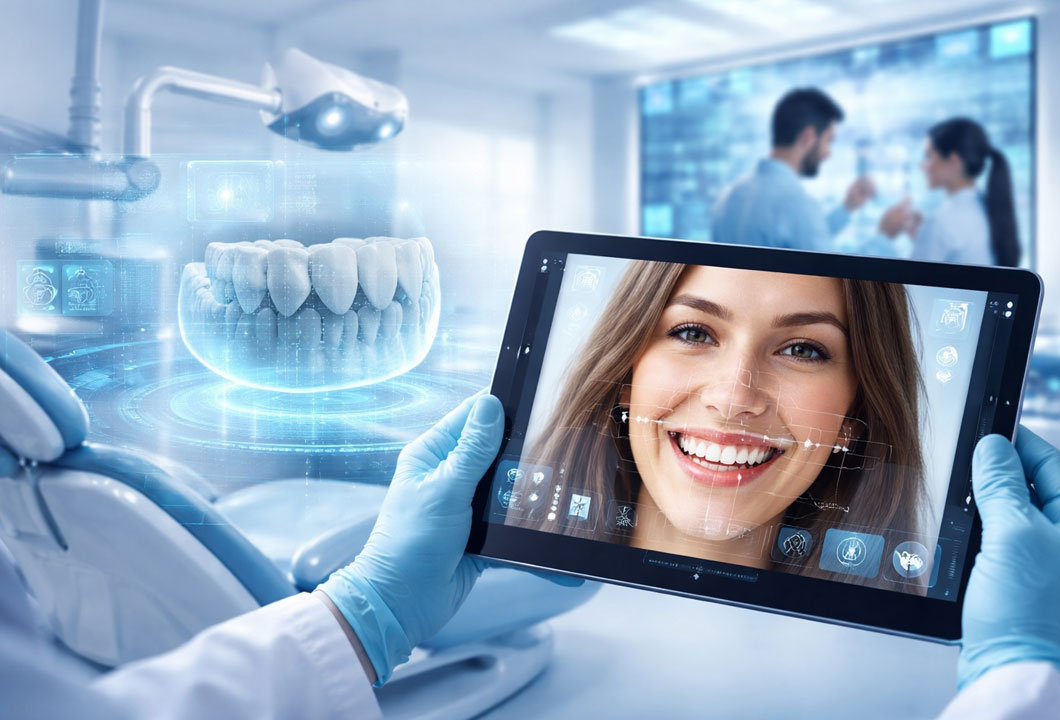
During a DSD consultation, clinicians analyze high-quality photos and videos of the patient’s face and smile. Using facial reference lines and aesthetic principles, they design a personalized smile preview. This visual storytelling transforms abstract treatment plans into emotionally compelling experiences.
Practice Tip:
Create a dedicated Digital Consultation Room with a large monitor for presenting smile previews. This small environmental upgrade signals professionalism and significantly boosts case acceptance.
The Case Acceptance Revolution
- Traditional treatment presentations relied heavily on verbal explanations and printed materials. Patients were expected to imagine the outcome.
- DSD eliminates guesswork. When patients see their own transformed smile on screen, the gap between considering treatment and committing to it narrows dramatically. Practices using formal DSD workflows consistently report two to three times higher acceptance rates for elective procedures.
- Additionally, because patients approve the design before treatment begins, post-treatment adjustments and disputes are reduced.
Clinical Benefits Beyond Aesthetics
While often associated with cosmetic dentistry, digital workflows benefit all disciplines:
- Implantology: Guided implant placement improves precision and reduces surgical risk.
- Orthodontics: Digital models and AI-driven planning enhance predictability and monitoring.
- Restorative Dentistry: CAD/CAM reduces impression errors and remakes.
- Periodontics: Digital records allow earlier detection and objective tracking of bone loss.
- Endodontics: CBCT imaging improves identification of complex canal anatomy.
The Business Case for Full Digitization
- Although the initial investment can be significant, the return on investment is compelling.
- Costs eliminated include impression materials, stone models, shipping fees, and remakes due to distortion. Revenue increases through faster workflows, premium service offerings, and higher case acceptance rates.
- Many fully digital practices report breaking even within 18 to 30 months, followed by sustained improvements in profitability and efficiency
It’s a Culture Shift — Not Just Technology
- Technology alone does not guarantee success. The most common obstacle to digital adoption is lack of team integration.
- Successful practices invest equally in technology, training, and team culture. Every team member must understand and confidently communicate the digital workflow.
Action Step:
Before purchasing new technology, assess your team’s digital literacy and enthusiasm. Conduct internal workshops to maximize adoption and accelerate ROI. The Future of Digital Smile Design Innovation continues rapidly in digital dentistry. Emerging developments include:
- AI-generated smile proposals that automatically suggest optimized designs.
- Augmented reality try-ins allowing real-time smile visualization via tablets or smartphones.
- Fully automated milling and 3D printing with AI quality control.
- Cloud-based collaboration platforms for seamless case sharing between clinicians and laboratories.
- Practices that establish a digital foundation today will adopt these advances effortlessly.
Conclusion
Digital dentistry is transitioning from a competitive advantage to a baseline expectation.Digital Smile Design represents transparency, precision, and patient-centered care. Practices that fully integrate digital workflows are not simply future-proofing their businesses — they are redefining modern dentistry.The real question is not whether your practice will go digital.The question is how long you can afford to wait.