
Beyond the X-Ray – Your Dentist Just Got a Tech Upgrade
Ever wonder what’s happening behind the scenes at your dental office? Beyond the whirring drills and the minty mouthwash, a quiet revolution is underway. Get ready for a surprise – it’s getting smarter! AI isn’t just for sci-fi anymore; it’s quietly transforming dental practices, making everything from scheduling your next cleaning to spotting a tiny cavity more efficient and precise. Think less paperwork, more perfect smiles! But why should we, as patients, even care? Because this tech upgrade ultimately translates to better care, smoother visits, and a healthier you. It’s about shifting from reactive treatments to proactive prevention, empowered by algorithms and data.
The Good Old Days (and How Far We’ve Come): A Brief History of Dental Tech
Let’s take a wistful stroll down memory lane, shall we? Back in the Day, remember when dental records were all paper, precariously stacked and prone to mysterious coffee stains? Appointments were a phone call marathon, a frustrating dance of hold music and busy signals. Then came the Early Steps (1980s-1990s). We saw rudimentary digital tools emerge, and early CAD/CAM systems cautiously stepping in, primarily focused on the actual fixing of teeth – the crafting of crowns and bridges with nascent computer assistance.
But the real Modern Shift (2000s-Present) is where things get interesting. The rise of machine learning and deep learning marked a profound inflection point. Suddenly, AI wasn’t just for clinical tasks; it began tackling the whole office, transforming administrative and diagnostic processes. It’s a shift from clunky to clever. Manual scheduling became smart, billing became streamlined, and patient data, once a jumbled mess, became a treasure trove of insights, all thanks to AI hitting its stride in the last decade.
Your New (Invisible) Assistant: What AI is Doing Right Now
Consider AI as your dentist’s new, virtually invisible, assistant. Its presence is subtle, yet its impact is profound.
The Front Office MVP:
- Goodbye Hold Music: AI-powered scheduling systems are now commonplace, learning patient preferences and optimizing appointment slots. Appointment reminders are automated, and AI-driven chatbots are available 24/7 to answer your FAQs, freeing up staff to focus on more complex tasks.
- Billing Bliss: The labyrinthine world of insurance claims is being navigated with increasing ease by AI. Algorithms can identify and rectify errors, streamline the submission process, and reduce those pesky claim denials that often leave patients frustrated.
The Data Whisperer:
- Making Sense of *All* the Info: AI’s capacity to sift through vast quantities of patient data is truly remarkable. By identifying patterns and correlations that would be impossible for a human to discern, AI helps personalize your care. For instance, AI might detect a link between your oral hygiene habits and your risk of developing gum disease, leading to tailored recommendations for improved oral health.
- Predictive Powers: Perhaps one of the most promising applications of AI in dentistry is its ability to predict potential issues before they escalate. AI can analyze your dental history, lifestyle factors, and even genetic predispositions to flag potential risks, such as the development of cavities or the onset of periodontal disease. This proactive approach allows for early intervention and can help keep your teeth healthier for longer.
The Dentist’s Extra Pair of Eyes:
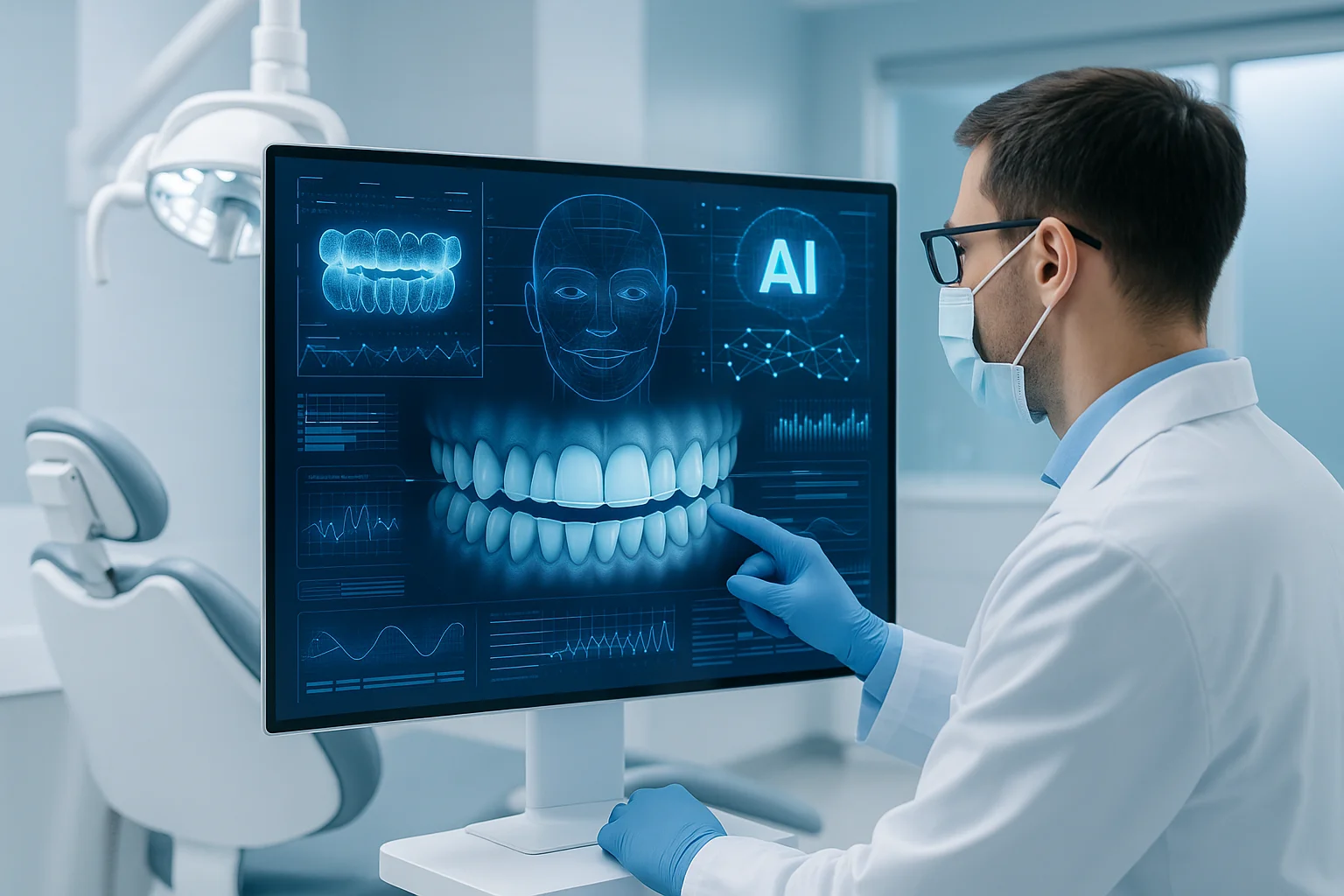
- Super Sight: AI algorithms are being trained to analyze X-rays and scans with superhuman precision. These algorithms can detect subtle anomalies, such as early signs of cavities or subtle changes in bone structure, that even a seasoned dental professional might miss. Think of it as a super-accurate second opinion, ensuring that nothing is overlooked.
- Treatment Blueprint: From orthodontic treatments to complex implant procedures, AI is helping dentists plan with pinpoint accuracy. By analyzing 3D scans and patient data, AI can create detailed treatment plans that minimize risks and optimize outcomes.
The Buzz: What Everyone Thinks About This AI Dental Future
So, what’s the word on the street? What do dentists and patients think about this AI-powered future of dentistry?
Dentists Weigh In:
Generally, the sentiment among dentists is overwhelmingly positive. They view AI as a powerful tool that augments their abilities, rather than replacing them. AI’s ability to enhance diagnostic accuracy, streamline administrative tasks, and personalize treatment plans is seen as a game-changer, freeing dentists to focus on what they do best: providing compassionate care to their patients.
Patients Speak Up:
Patient attitudes are characterized by cautious optimism. Many are open to the idea of an “AI dentist,” particularly if it leads to more accurate diagnoses and earlier detection of dental problems. Some are even willing to switch to a dental practice that embraces AI technology. However, there’s a crucial caveat: patients still value the human touch and emphasize the importance of human oversight in the dental care process.
The Money Talk:
The dental practice software market is experiencing a period of unprecedented growth, fueled by increasing investor confidence in AI’s transformative potential. This influx of capital is driving innovation and accelerating the adoption of AI-powered solutions across the dental industry.
Uh-Oh, The Cavities (and Headaches): Controversies and Challenges
Of course, no technological revolution is without its share of challenges and controversies. The integration of AI into dentistry presents a unique set of hurdles that must be addressed thoughtfully and proactively.
The Price Tag:
AI systems can be expensive to implement, with high setup costs and ongoing maintenance fees that can be a significant burden for smaller practices.
Tech Tangles:
Integrating new AI systems with existing software can be a complex and frustrating process. Compatibility issues and data migration challenges can lead to initial disruptions and a steep learning curve for staff.
Data Dilemmas:
AI algorithms are only as good as the data they are trained on. If the data is incomplete, biased, or inaccurate, the AI’s recommendations may be flawed or misleading.
Who’s to Blame? (The Legal Bits):
The legal ramifications of AI-assisted diagnoses and treatment decisions are still being worked out. If an AI makes a diagnostic error, who is ultimately responsible? The dentist? The AI developer? The legal landscape is rapidly evolving to address these complex questions.
The Human Factor:
- “Will AI take my job?” The integration of AI into dentistry has raised concerns among dental staff about potential job displacement.
- “Am I trusting a robot too much?” Some dentists worry about the potential for “automation bias,” the tendency to blindly accept AI suggestions without exercising critical judgment.
- “Where’s the empathy?” Patients are concerned about the potential loss of the personal touch in dental care as AI becomes more prevalent.
Privacy Please!:
AI systems collect and process vast amounts of sensitive patient data, raising significant concerns about data security and privacy. Ensuring compliance with regulations like HIPAA is paramount.
Fairness First:
There’s a risk that AI algorithms, if trained on biased data, could inadvertently perpetuate disparities in dental care based on a patient’s race, ethnicity, or socioeconomic status. Addressing algorithmic bias is crucial to ensure equitable access to quality dental care.
Crystal Ball Gazing: What’s Next for AI and Your Sparkling Smile
Peering into the future, we can envision a world where AI plays an even more transformative role in dentistry.
- Hyper-Personalized Care: Imagine AI analyzing your unique genetic makeup, lifestyle factors, and environmental exposures to predict your specific dental risks. Based on this personalized risk assessment, AI could recommend tailored preventive strategies to help you maintain optimal oral health for life.
- Virtual Visits & Beyond: Teledentistry, already gaining traction, will become even more sophisticated with the integration of AI. AI-powered diagnostic tools could enable remote diagnosis of dental problems, expanding access to care for patients in underserved areas.
- In-Office Fab Labs: AI will be seamlessly integrated with 3D printing and CAD/CAM technologies, enabling dental practices to fabricate custom crowns, bridges, and implants with unparalleled speed and precision, all within the confines of the office.
- Smart Everything: From toothbrushes that provide real-time feedback on brushing technique to apps that manage your entire oral health journey, AI-powered tools will empower you to take control of your dental health like never before.
- From Reactive to Proactive: The biggest paradigm shift will be the transition from reactive treatment to proactive prevention. AI will be the ultimate partner in preventing dental problems before they even arise, ushering in an era of lifelong oral health.
The Bottom Line: Bracing for a Brighter Dental Future
AI isn’t just a passing fad; it’s a foundational shift in how dental practices operate and how we experience dental care. While challenges remain – cost, ethics, the human touch – the overall outlook is overwhelmingly positive for more efficient, precise, and personalized dentistry. So next time you visit the dentist, remember, there might be a silent, super-smart assistant working hard to give you the best smile possible!