

In the modern era of dentistry, the choice between saving a natural tooth and opting for an extraction is one of the most critical decisions a patient will face. At DenTrends, we analyze this through the lens of DenTech—combining biological preservation with state-of-the-art restorative technology.
Whether you are dealing with a persistent ache or a sudden fracture, understanding the clinical protocols behind these procedures is the first step toward long-term oral health.
1. The Gold Standard: Root Canal Therapy (RCT)
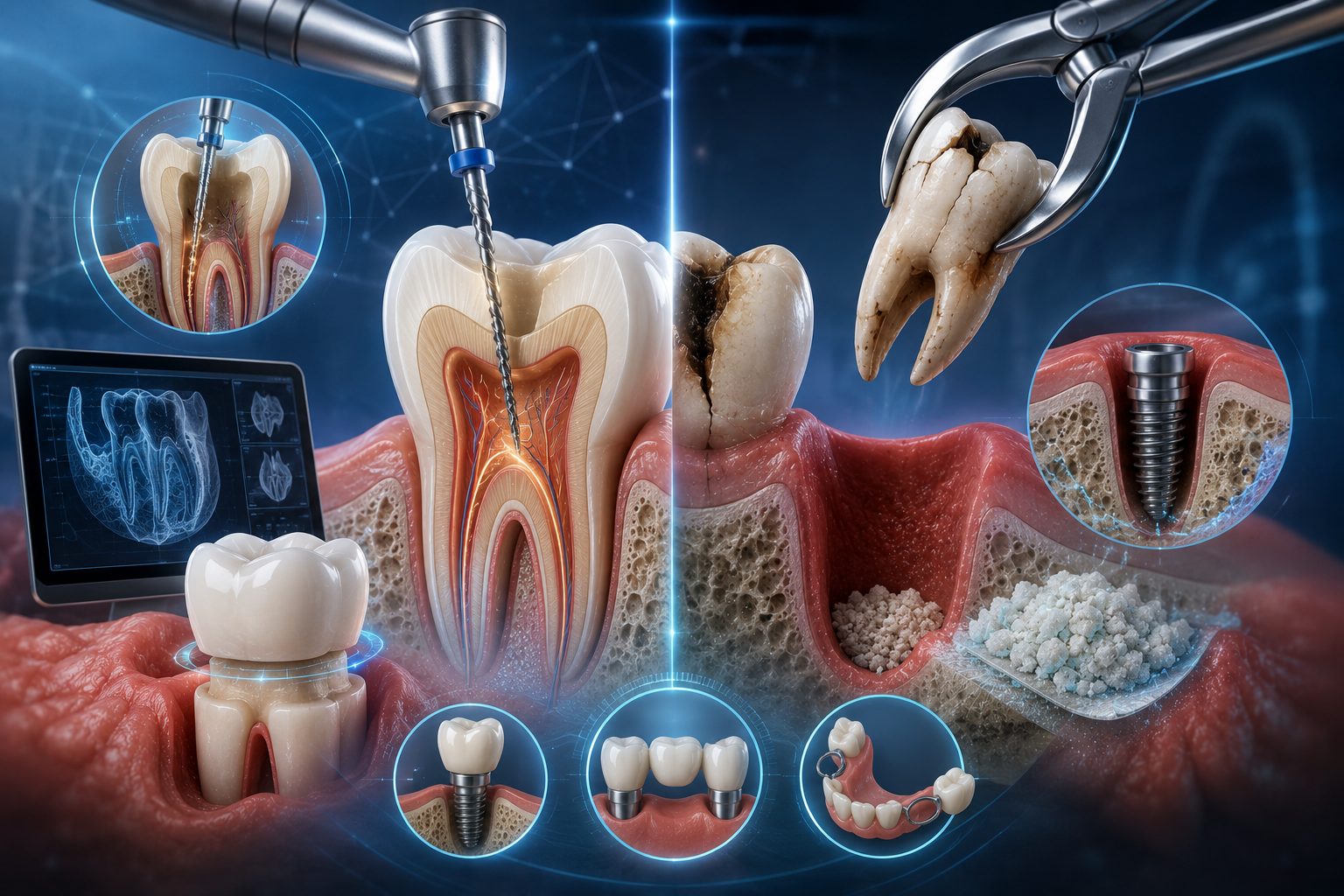
A root canal is a sophisticated restorative procedure designed to save a tooth that has been compromised by deep decay, trauma, or internal infection. When the pulp—the soft tissue containing nerves and blood vessels—becomes inflamed, a root canal is the only way to retain the natural tooth structure.
- The Final Step: Because a treated tooth becomes brittle over time, it is almost always reinforced with a permanent porcelain crown to prevent future fractures.
- The Precision Process: Using microscopic endodontics and antimicrobial irrigants, the clinician “scrubs” the internal canals to remove bacteria.
- The 2026 Edge: Modern techniques utilize Nickel-Titanium (NiTi) rotary files and 3D imaging (CBCT) to map complex root anatomy with micron-level accuracy.
2. When the Tooth Cannot Be Saved: The Extraction Path
While US dentists aim for 100% preservation, certain “Level 4” clinical complications make extraction the safer, more predictable route for your systemic health.
Typical Causes for Extraction:
- Recurrent Infection: If a previous root canal fails and cannot be retreated.
- Vertical Root Fractures: Cracks that extend below the bone line cannot be repaired.
- Advanced Periodontal Disease: If the supporting bone is too weak, the tooth loses its foundation.
- Internal Resorption: A condition where the body’s own cells begin to dissolve the tooth from within.
3. The Systematic Extraction Protocol
If extraction is the chosen path, our priority shifts to Patient Comfort and Bone Preservation.
- Socket Grafting (Bone Preservation): In 2026, it is standard practice to place bone-grafting material into the empty socket. This prevents the jawbone from collapsing and creates a stable foundation for a future Dental Implant.
- Preparation: High-resolution scans evaluate the root alignment. Local anesthetics ensure the procedure is entirely painless.
- Luxation & Removal: Specialized instruments gently loosen the tooth from the periodontal ligaments, minimizing trauma to the surrounding jawbone.
- Socket Debridement: The area is irrigated and cleaned of all infected debris.
4. Aftercare: Avoiding the “Dry Socket”
The most critical phase of recovery is the first 72 hours. The goal is to protect the fibrin clot that forms in the socket.
- The “No-Go” List: Avoid smoking, using straws, or vigorous spitting. These actions create suction that can dislodge the clot, leading to a painful condition known as Dry Socket (Alveolar Osteitis).
- Modern Recovery: Many clinics now use PRF (Platelet-Rich Fibrin) therapy—using the patient’s own growth factors to accelerate tissue regeneration and virtually eliminate the risk of complications
5. Life After Extraction: Replacement Options
Leaving a gap in your smile can lead to “drifting,” where adjacent teeth tilt into the space, causing bite misalignment.
| Option | Best For… | Key Benefit |
| Dental Implant | Long-term durability | Mimics a real tooth; prevents bone loss. |
| Fixed Bridge | Rapid restoration | Non-surgical; completed in two visits. |
| Partial Denture | Multiple missing teeth | Most cost-effective solution. |
Final Thought
The decision between a root canal and an extraction is a balance of biological cost versus prognostic certainty. A root canal saves your natural ligament, allowing you to “feel” your bite, while an extraction followed by an implant offers a “bionic” solution that is immune to future cavities.
Don’t ignore the ache. Whether you need an emergency root canal or a guided extraction, early intervention is the key to maintaining your success and your smile in 2026.