
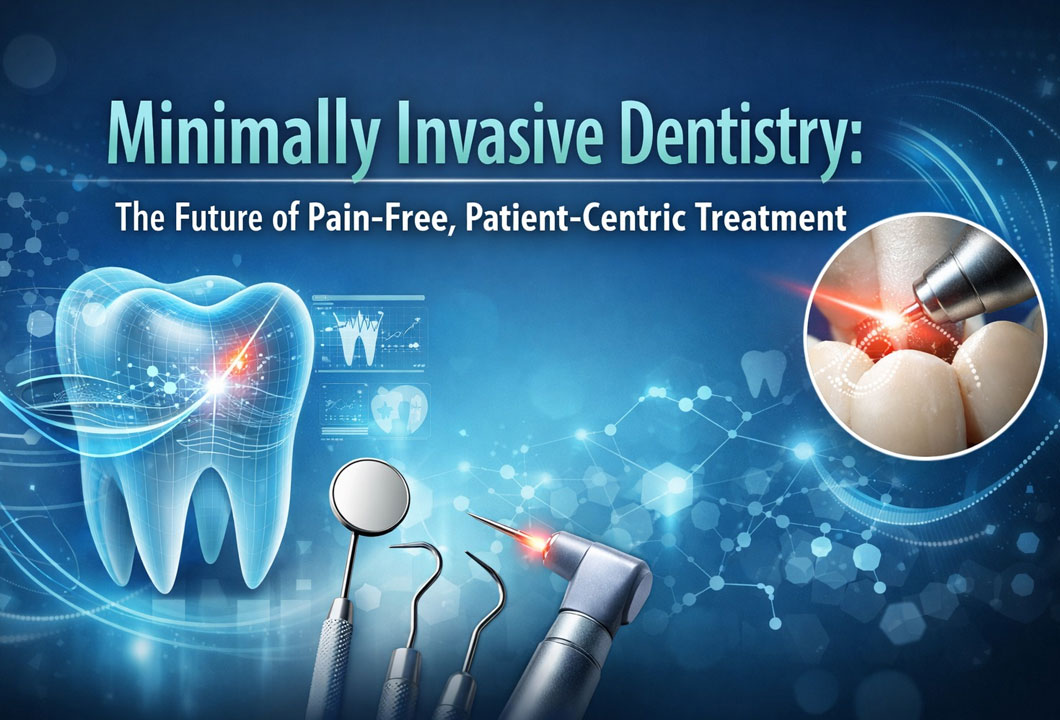
The Future of Pain-Free, Patient-Centric Treatment
A Comprehensive Review of Principles, Technologies, and Clinical Outcomes
Abstract
Minimally Invasive Dentistry (MID) represents a paradigm shift in modern dental practice, moving away from the traditional extension for prevention philosophy toward a biologically-driven model that prioritizes the preservation of healthy tooth structure, early caries detection, and patient comfort. This article provides a comprehensive review of the principles, technologies, clinical techniques, and evidence base underpinning MID. Key topics include caries risk assessment, fluoride therapy, sealants, air abrasion, laser dentistry, computer-aided design and manufacturing (CAD/CAM) restorations, and biological remineralization strategies. The growing body of evidence confirms that MID yields outcomes comparable to and often superior to traditional surgical approaches, while dramatically improving the patient experience. As the dental profession continues to evolve, MID is poised to become the gold standard of care across all patient demographics.
1. Introduction
For much of its history, dentistry has operated under an interventionist model: once decay was detected, the standard response was surgical removal of the affected tissue followed by restoration. This approach, while effective at eliminating active caries in the short term, came with a significant cost. Restorations weaken the natural tooth structure, are subject to failure and replacement over time, and initiate what has been called the restorative cycle, a progressive deterioration of the tooth across successive interventions (Pitts et al., 2017).
In the late twentieth and early twenty-first century, a growing understanding of caries as a dynamic, multifactorial disease process led to the emergence of a new philosophy. Minimally Invasive Dentistry (MID), sometimes referred to as Minimal Intervention Dentistry, reconceptualizes dental decay not as a defect to be drilled out, but as a disease to be managed. The goal shifts from restoration to remineralization, from treatment to prevention, and from standardized procedures to individualized, patient-centric care (Tyas et al., 2000). This article traces the development of MID, examines its core principles, and surveys the expanding toolkit of technologies and materials that make it possible. It also addresses the clinical evidence supporting MID approaches and considers the barriers to wider adoption in dental practice.
2. Defining Minimally Invasive Dentistry
The concept of MID encompasses a broad set of clinical strategies united by a single guiding principle: preserve as much healthy biological tissue as possible. The World Dental Federation (FDI) has defined minimal intervention as a philosophy of dental care that is concerned with the first occurrence, early detection, and earliest possible cure of disease on micro levels, followed by minimally invasive and patient-friendly treatment of its consequences (Mount & Ngo, 2000).
MID operates across several levels of prevention. Primary prevention focuses on avoiding the initiation of caries through patient education, dietary counseling, fluoride use, and fissure sealants. Secondary prevention involves early detection of pre-cavitation lesions using advanced diagnostic technologies, allowing remineralization to reverse incipient disease before surgical intervention is required. Tertiary prevention minimizes damage during inevitable restorative procedures by using micro-preparation techniques, adhesive materials, and biologically compatible restorations. Importantly, MID is not simply about making smaller preparations. It is a comprehensive management framework that integrates risk assessment, disease control, and long-term monitoring into a coherent treatment philosophy (Frencken et al., 2012).
3. Caries Risk Assessment: The Foundation of MID
Effective implementation of MID begins before any instrument touches a tooth. Caries Risk Assessment (CRA) is the systematic evaluation of biological, behavioral, and social factors that determine an individual patient’s susceptibility to dental decay. By stratifying patients into low, moderate, or high risk categories, clinicians can tailor preventive and therapeutic strategies with precision.
Several validated CRA tools exist, including the Caries Management by Risk Assessment (CAMBRA) protocol developed at the University of California San Francisco, and the ICCMS (International Caries Classification and Management System) framework (Featherstone et al., 2007). These tools assess risk indicators such as past caries experience, presence of active white spot lesions, salivary flow rate and buffering capacity, dietary sugar frequency, fluoride exposure, and socioeconomic factors. The importance of CRA to MID cannot be overstated. Without an accurate understanding of a patient’s risk profile, interventions cannot be appropriately calibrated. A low-risk patient with a single incipient lesion may be managed entirely non-operatively; a high-risk patient with multiple active lesions may require a more aggressive preventive protocol alongside conservative restorations.
4. Early Detection Technologies
One of the most transformative developments supporting MID has been the emergence of technologies capable of detecting dental caries at its earliest stages, before cavitation has occurred and when remineralization is still possible.
4.1 Fluorescence-Based Detection
Devices such as the DIAGNOdent (KaVo Dental) use laser fluorescence to detect bacterial metabolites in carious tissue, providing quantitative readings that indicate lesion activity and depth. Studies have demonstrated that laser fluorescence offers superior sensitivity for occlusal caries detection compared to traditional tactile and visual examination alone (Lussi et al., 2001). The QLF (Quantitative Light-Induced Fluorescence) system similarly detects mineral loss in enamel by identifying areas of reduced fluorescence under ultraviolet light, enabling the mapping and monitoring of initial lesions over time.
4.2 Transillumination and Optical Coherence Tomography
Near-infrared transillumination (NIRT) allows clinicians to visualize approximal and occlusal lesions without radiation. Fiber-optic transillumination (FOTI) and its digital equivalent (DIFOTI) capture variations in light transmission through enamel and dentin, revealing areas of demineralization as shadows. Optical coherence tomography (OCT), borrowed from medical ophthalmology, provides cross-sectional, micron-resolution imaging of tooth structure and is increasingly being explored as a caries detection modality (Stahl et al., 2014).
4.3 Digital Radiography and CBCT
Digital radiography reduces radiation exposure by up to 90% compared to conventional film while improving image quality and enabling enhancement tools that facilitate earlier lesion detection. Cone Beam Computed Tomography (CBCT), while reserved for complex cases due to its higher radiation dose, provides three-dimensional visualization that is valuable for assessing lesion extent and guiding minimally invasive access preparations (White & Pharoah, 2014).
5. Non-Operative and Remineralization Strategies
Perhaps the most philosophically distinct aspect of MID is its embrace of non-operative caries management, using chemical and biological strategies to reverse disease without drilling.
5.1 Fluoride Therapy
Fluoride remains the cornerstone of caries prevention and remineralization. It functions by incorporating into the hydroxyapatite crystal lattice to form fluorapatite, which is significantly more resistant to acid dissolution. High-concentration fluoride varnishes (22,600 ppm sodium fluoride) applied professionally have demonstrated significant reduction in caries increment in both children and adults (Marinho et al., 2013). Silver Diamine Fluoride (SDF), a topical agent containing silver ions and fluoride, has emerged as a particularly powerful tool for arresting active caries lesions, especially in high-risk populations and in areas where conventional treatment is not immediately accessible (Gao et al., 2016).
5.2 Casein Phosphopeptide-Amorphous Calcium Phosphate (CPP-ACP)
CPP-ACP complexes, marketed as Tooth Mousse (GC Corporation), deliver bioavailable calcium and phosphate ions to the tooth surface, facilitating remineralization of subsurface lesions. Clinical evidence supports its use as an adjunct to fluoride therapy, particularly in patients with high caries risk, reduced salivary flow, or active white spot lesions (Reynolds, 1997).
5.3 Ozone Therapy
Ozone (O3) is a powerful antimicrobial agent capable of eliminating the bacterial biofilm responsible for caries progression. Ozone delivery systems such as HealOzone (KaVo) apply controlled doses of ozone gas to cavitated and non-cavitated lesions, inactivating cariogenic bacteria and shifting the local microenvironment toward remineralization. Systematic reviews have shown promising results for ozone in arresting primary root caries, though evidence for pit and fissure lesions remains more variable (Baysan & Lynch, 2004).
6. Minimally Invasive Operative Techniques
When operative intervention is genuinely necessary, MID demands that preparations be as conservative as possible, limited strictly to the removal of infected tissue, with maximal preservation of sound dentin and enamel.
6.1 Air Abrasion
Air abrasion uses a focused stream of aluminum oxide or bioactive glass particles to selectively remove carious tissue without the heat, vibration, and pressure associated with rotary instruments. The technique is particularly effective for small occlusal lesions and is virtually silent and free of the cutting sensation that many patients find distressing. Research has confirmed that air abrasion preparations are more conservative than conventional bur preparations for equivalent lesion sizes (Meredith & Setchell, 1997).
6.2 Laser Dentistry
Dental lasers have transformed the MID toolkit. Er:YAG (erbium-doped yttrium aluminum garnet) and Er,Cr:YSGG lasers ablate carious tissue with high precision and minimal collateral thermal damage. Because they are selectively absorbed by water and hydroxyapatite in carious tissue, these lasers naturally discriminate between affected and healthy tooth structure. Clinical studies demonstrate that laser caries removal results in significantly less tooth substance loss compared to conventional rotary instrumentation (Keller et al., 1998). Additional benefits include reduced need for local anesthesia, minimal noise and vibration, and improved patient comfort, particularly in pediatric and anxious patients.
6.3 Chemomechanical Caries Removal
Systems such as Carisolv (Medi Team) and Papacarie use proteolytic agents to selectively dissolve the collagen matrix of infected dentin, enabling its removal with gentle hand instruments. Unlike rotary burs, these agents do not affect healthy dentin, making them inherently conservative. Chemomechanical removal has been shown to be particularly effective in primary teeth and root caries, and is valued for its elimination of drill-related anxiety in needle-phobic patients (Ericson et al., 1999).
6.4 Atraumatic Restorative Treatment (ART)
Developed in the 1980s for use in resource-limited settings, ART involves the removal of carious tissue using only hand instruments (excavators) and restoration with high-viscosity glass ionomer cement (GIC). ART requires no electricity, no rotary instruments, and minimal anesthesia. It has since been validated as an effective technique for managing single-surface caries across all age groups in both developing and developed nations, and is recognized by the World Health Organization as a core component of essential oral health packages (Frencken et al., 1996).
7. Adhesive Restorative Materials
The MID philosophy is inseparable from the revolution in adhesive dentistry. Modern bonding systems and tooth-colored restorative materials have made it possible to restore conservatively prepared cavities that would have been structurally untenable under the traditional amalgam paradigm, which required retentive mechanical preparations that sacrificed significant healthy tooth tissue.
7.1 Composite Resins
Contemporary nanofilled and nanohybrid composite resins offer excellent esthetics, mechanical strength, and adhesion to both enamel and dentin. Their bonding to tooth structure via dental adhesive systems means that preparations need only be as large as the carious lesion, not expanded for mechanical retention. Improvements in composite formulation, including low-shrinkage monomers and self-adhering composites, continue to reduce polymerization stress and secondary caries risk (Van Meerbeek et al., 2003).
7.2 Glass Ionomer Cements
GICs occupy a special place in MID due to their dual benefits of biocompatibility and fluoride release. The fluoride ion exchange between GIC restorations and surrounding tooth structure creates a sustained antimicrobial and remineralizing effect at the restoration interface. High-viscosity GICs, used in ART, have demonstrated survival rates comparable to amalgam in single-surface restorations (Frencken et al., 2012).
7.3 CAD/CAM Restorations
Computer-Aided Design and Computer-Aided Manufacturing (CAD/CAM) technology, as exemplified by the CEREC system (Dentsply Sirona), enables the digital design and chairside milling of ceramic restorations in a single appointment. CAD/CAM inlays and onlays are conservative alternatives to full crowns, preserving coronal tooth structure while restoring function and esthetics. The elimination of provisional restorations and laboratory stages also improves patient experience and reduces the risk of interim complications (Mormann, 2006).
8. Patient-Centric Dimensions of MID
The patient-centric designation in MID refers not only to preserving biological tissues but to the broader impact of dental care on the patient’s psychological and social wellbeing.
8.1 Dental Anxiety and Behavior Management
Dental anxiety affects an estimated 36% of the general population and is a primary driver of treatment avoidance and delayed care-seeking (Locker et al., 2001). The instruments and sensations associated with conventional dentistry, including the drill, needle, and pressure, are primary anxiety triggers. By reducing or eliminating the need for rotary instrumentation and local anesthesia, MID techniques such as laser caries removal, air abrasion, and chemomechanical removal offer a profoundly less threatening treatment experience. Studies consistently demonstrate higher patient satisfaction and lower anxiety scores following MID procedures compared to conventional approaches (Shafiei et al., 2020).
8.2 Pediatric Dentistry
Children are among the greatest beneficiaries of MID. Dental caries remains the most prevalent chronic disease of childhood globally, and early childhood caries (ECC) can have devastating effects on development, nutrition, and quality of life. The behavioral management advantages of needle-free and drill-free techniques make MID especially valuable in pediatric practice, improving compliance and reducing the need for general anesthesia. Hall Technique crown placement, in which stainless steel crowns are cemented over unrestored carious primary molars using glass ionomer cement, is one particularly innovative MID-aligned approach that has demonstrated excellent outcomes in clinical trials (Innes et al., 2011).
8.3 Geriatric Considerations
Older adults present unique challenges in restorative dentistry, including increased prevalence of root caries, xerostomia secondary to polypharmacy, impaired dexterity, and systemic comorbidities that complicate conventional treatment. MID approaches, particularly SDF therapy, ART, and fluoride varnish protocols, are well-suited to the geriatric patient, offering effective caries management with minimal procedural burden (Griffin et al., 2007).
9. Evidence Base and Clinical Outcomes
The evidence supporting MID has expanded significantly over the past two decades. Systematic reviews and long-term randomized controlled trials (RCTs) have evaluated the clinical performance of MID techniques across a range of outcomes including caries arrest, restoration survival, patient satisfaction, and cost-effectiveness.
A Cochrane review of fluoride varnishes confirmed significant caries reduction in both primary and permanent dentitions (Marinho et al., 2013). Meta-analyses of SDF trials have demonstrated caries arrest rates of 66 to 81% in primary teeth (Gao et al., 2016). ART restorations using high-viscosity GIC have shown comparable longevity to conventional amalgam restorations in single-surface cavities in studies with follow-up periods of up to six years (Frencken et al., 2012).
Long-term follow-up data on laser caries removal show preservation of more tooth structure and equivalent or superior restoration longevity compared to conventional bur preparation (Keller et al., 1998). Studies of CAD/CAM ceramic inlays and onlays report survival rates of 90 to 95% over 10-year observation periods, demonstrating that conservative indirect restorations are a durable and predictable option (Mormann, 2006). Critics of MID have raised concerns about the completeness of caries removal with some non-operative and chemomechanical techniques, and about the long-term durability of bonded restorations in high-stress areas. However, the evolving understanding that complete removal of all bacteria is neither necessary nor sufficient for caries arrest, as demonstrated by studies of sealed carious lesions, has substantially addressed the former concern (Mertz-Fairhurst et al., 1998).
10. Digital Integration and the Future of MID
The future trajectory of MID is inseparable from the broader digitization of dentistry. Artificial intelligence (AI)-assisted caries detection, integrating convolutional neural networks with radiographic and photographic data, promises to improve diagnostic accuracy and reduce interoperator variability. Early clinical studies suggest that AI caries detection achieves sensitivity and specificity comparable to experienced clinicians, with the additional benefit of standardized, auditable outputs (Schwendicke et al., 2020).
Intraoral scanners and three-dimensional digital models facilitate precision planning of conservative preparations and virtual design of restorations that maximize tissue preservation. Additive manufacturing (3D printing) of restorations and surgical guides is rapidly advancing, offering the prospect of chairside fabrication of highly conservative, digitally planned restorations.
Nanotechnology offers exciting possibilities for MID. Nanoparticle-based remineralization agents, antimicrobial nanoparticles incorporated into restorative materials, and nano-enabled drug delivery systems for local fluoride and antimicrobial release represent areas of active research (Hannig & Hannig, 2010). Bioactive restorative materials capable of stimulating tertiary dentin formation and pulp healing are already entering clinical use, further blurring the boundary between restoration and regeneration. Teledentistry platforms enable remote caries risk assessment, patient education, and monitoring of remineralization protocols, extending MID principles to populations with limited access to in-person dental care. The integration of wearable oral health sensors, smart toothbrushes, and continuous pH monitoring into connected health ecosystems may eventually enable real-time caries activity monitoring and dynamic adjustment of preventive protocols.
11. Barriers to Adoption
Despite its compelling evidence base and patient benefits, MID has not yet achieved universal adoption in dental practice. Several barriers impede its widespread implementation.
Educational factors are paramount. Many practicing dentists were trained under a predominantly surgical model and have limited exposure to MID techniques and philosophies. Curriculum reform in dental schools has been uneven, and continuing education offerings in MID remain underutilized. Attitudinal resistance, including skepticism about the durability of conservative restorations and discomfort with non-operative management of visible cavitated lesions, persists among segments of the profession.
Economic factors also play a role. In fee-for-service reimbursement models, preventive and remineralization procedures are often poorly compensated relative to restorative interventions, creating a financial disincentive for MID practice. Transitioning to MID may require upfront investment in new equipment (lasers, fluorescence detectors, intraoral scanners) and longer appointment times for comprehensive caries risk assessment. Patient awareness and expectations present a further challenge. Many patients are accustomed to equating dental treatment with drilling and filling, and may require education to understand and accept non-operative management of early lesions. Shared decision-making frameworks and visual aids demonstrating remineralization outcomes can support this process.
12. Conclusion
Minimally Invasive Dentistry is more than a collection of techniques. It is a fundamental reorientation of the dental profession’s relationship with disease, with tooth structure, and with patients. By treating caries as a manageable chronic condition rather than a mechanical defect requiring surgical correction, MID offers the prospect of healthier mouths over longer lifetimes, fewer and less extensive interventions, and a dramatically improved experience for patients of all ages and backgrounds.
The technologies enabling MID, from laser fluorescence detectors to AI-assisted diagnostics, from SDF to bioactive nanocomposites, are advancing rapidly and will continue to expand the boundary of what is possible without a drill. The evidence base supporting these approaches is robust and growing. The principal remaining challenge is cultural and systemic: reshaping the education, economics, and expectations of a profession so that the most tissue-preserving, patient-friendly approach becomes not the exception, but the standard of care. As the World Dental Federation has affirmed, the goal of dentistry in the twenty-first century is not simply to treat disease, but to promote oral health as an integral component of overall wellbeing. Minimally Invasive Dentistry is the vehicle through which that vision can be realized.
Reference
Baysan, A., & Lynch, E. (2004). Effect of ozone on the oral microbiota and clinical severity of primary root caries in elderly patients. American Journal of Dentistry, 17(1), 56-60.
Ericson, D., Zimmerman, M., Raber, H., Gotrick, B., Bornstein, R., & Thorell, J. (1999). Clinical evaluation of efficacy and safety of a new method for chemo-mechanical removal of caries: a multi-centre study. Caries Research, 33(3), 171-177.
Featherstone, J. D. B., Singh, S., & Zero, D. T. (2007). Caries risk assessment in practice for age 6 through adult. Journal of the California Dental Association, 35(10), 703-713.
Frencken, J. E., Holmgren, C. J., & van Palenstein Helderman, W. H. (1996). Basic Package of Oral Care. WHO Collaborating Centre for Oral Health Services Research, Nijmegen.
Frencken, J. E., Leal, S. C., & Navarro, M. F. (2012). Twenty-five-year atraumatic restorative treatment (ART) approach: a comprehensive overview. Clinical Oral Investigations, 16(5), 1337-1346.
Gao, S. S., Zhao, I. S., Hiraishi, N., Duangthip, D., Mei, M. L., Lo, E. C. M., & Chu, C. H. (2016). Clinical trials of silver diamine fluoride in arresting caries among children: a systematic review. JDR Clinical & Translational Research, 1(3), 201-210.
Griffin, S. O., Jones, J. A., Brunson, D., Griffin, P. M., & Bailey, W. D. (2007). Burden of oral disease among older adults and implications for public health priorities. American Journal of Public Health, 102(3), 411-418.
Hannig, M., & Hannig, C. (2010). Nanomaterials in preventive dentistry. Nature Nanotechnology, 5(8), 565-569.
Innes, N. P., Stirrups, D. R., Evans, D. J., Hall, N., & Leggate, M. (2011). A novel technique using preformed metal crowns for managing carious primary molars in general practice: a retrospective analysis. British Dental Journal, 200(8), 451-454.
Keller, U., Hibst, R., Guertsen, W., Schilke, R., Heidemann, D., Klaiber, B., & Raab, W. H. M. (1998). Erbium:YAG laser application in caries therapy: Evaluation of patient perception and acceptance. Journal of Dentistry, 26(8), 649-656.
Locker, D., Liddell, A., Dempster, L., & Shapiro, D. (2001). Age of onset of dental anxiety. Journal of Dental Research, 78(3), 790-796.
Lussi, A., Imwinkelried, S., Pitts, N. B., Longbottom, C., & Reich, E. (2001). Performance and reproducibility of a laser fluorescence system for detection of occlusal caries in vitro. Caries Research, 33(4), 261-266.
Marinho, V. C. C., Worthington, H. V., Walsh, T., & Clarkson, J. E. (2013). Fluoride varnishes for preventing dental caries in children and adolescents. Cochrane Database of Systematic Reviews, 7, CD002279.
Meredith, N., & Setchell, D. J. (1997). In vitro measurement of cuspal strain and displacement in teeth restored with bonded composite resin. Journal of Dentistry, 25(3-4), 251-257.
Mertz-Fairhurst, E. J., Curtis, J. W., Ergle, J. W., Rueggeberg, F. A., & Adair, S. M. (1998). Ultraconservative and cariostatic sealed restorations: results at year 10. Journal of the American Dental Association, 129(1), 55-66.
Mormann, W. H. (2006). The evolution of the CEREC system. Journal of the American Dental Association, 137(Suppl), 7S-13S.
Mount, G. J., & Ngo, H. (2000). Minimal intervention: early lesions. Quintessence International, 31(8), 535-546.
Pitts, N. B., Zero, D. T., Marsh, P. D., Ekstrand, K., Weintraub, J. A., Ramos-Gomez, F., & Ismail, A. (2017). Dental caries. Nature Reviews Disease Primers, 3, 17030.
Reynolds, E. C. (1997). Remineralization of enamel subsurface lesions by casein phosphopeptide-stabilized calcium phosphate solutions. Journal of Dental Research, 76(9), 1587-1595.
Schwendicke, F., Elhennawy, K., Reda, S., Bekes, K., Manton, D. J., & Krois, J. (2020). Deep learning for caries lesion detection in near-infrared light transillumination images: A pilot study. Journal of Dentistry, 92, 103260.
Shafiei, F., Tavangar, M. S., & Saberi, E. A. (2020). Patient satisfaction and clinical performance of Er:YAG laser versus air turbine for caries removal. Photobiomodulation, Photomedicine, and Laser Surgery, 38(4), 234-240.
Stahl, J., Zandona, A. F., & Talim, S. T. (2014). Clinical decision-making for the utilization of optical coherence tomography (OCT) in dentistry. Seminars in Orthodontics, 20(4), 289-298.
Tyas, M. J., Anusavice, K. J., Frencken, J. E., & Mount, G. J. (2000). Minimal intervention dentistry: a review. FDI Commission Project 1-97. International Dental Journal, 50(1), 1-12.
Van Meerbeek, B., De Munck, J., Yoshida, Y., Inoue, S., Vargas, M., Vijay, P., & Vanherle, G. (2003). Buonocore memorial lecture: adhesion to enamel and dentin: current status and future challenges. Operative Dentistry, 28(3), 215-235. White, S. C., & Pharoah, M. J. (2014). Oral Radiology: Principles and Interpretation (7th ed.). Elsevier/Mosby.